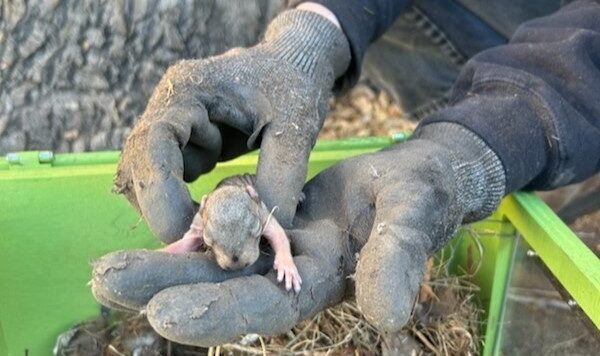
When we remove squirrels from Baltimore homes and businesses, protecting baby squirrels is always our top priority. Our humane wildlife control process uses specialized baby boxes and one-way doors to keep families together while safely removing them from your property. It’s careful, thoughtful work—and it’s something most homeowners never see.
At Skedaddle Humane Wildlife Control in Baltimore, we protect baby squirrels during removal by using insulated baby boxes placed near entry points and installing one-way doors that allow mothers to retrieve their young safely. This humane approach ensures the entire squirrel family leaves together—without harm, separation, or re-entry into your home.
If you’ve found squirrels in your attic, soffits, or walls, chances are there may be babies involved—especially in spring or late summer. In Maryland, squirrel birthing seasons typically peak between February–April and August–September, meaning baby squirrels are commonly present in Baltimore homes during those times.
Let’s take you behind the scenes.
Should You Remove Baby Squirrels Yourself?
No. You should never attempt to remove baby squirrels yourself.
Baby squirrels are completely dependent on their mother for warmth and survival. Removing them improperly can lead to injury, orphaning, or the mother desperately trying to re-enter your home—often causing more damage.
We understand the panic. You hear scratching in the attic. You see nesting material. Maybe insulation is scattered around your vents. Your first instinct might be to “handle it quickly.”
But here’s what often happens with DIY squirrel removal:
- Homeowners seal entry holes without realizing babies are still inside.
- The mother chews through new areas to reach her young.
- Babies die in inaccessible wall cavities.
- Structural damage increases.
- Health risks grow due to contamination.
 Squirrels may look small and harmless, but they are powerful chewers with strong maternal instincts. In Maryland, the most common species we deal with are:
- Eastern Gray Squirrels
- American Red Squirrels
- Southern Flying Squirrels
According to the Maryland Department of Natural Resources, gray squirrels are highly adaptable and thrive in urban environments like Baltimore, Towson, Columbia, and surrounding communities. They build nests—called dreys—in trees, but when trees are scarce or weather is harsh, attics become ideal substitutes.
And once babies are present, the situation becomes delicate.
“Squirrel populations often build up to high numbers in older residential areas which have lots of mature trees, particularly oaks. Because their reproductive rate is so high, live trapping is not usually effective. A homeowner’s best bet is to protect his house by screening openings and removing access to food sources, such as bird feeders.” (Maryland Department of Natural Resources)
Behind The Scenes: Our Humane Baby Box System
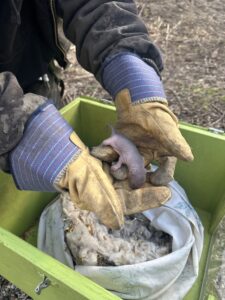
When you watch the video that accompanies this blog, you’ll see Dakota from our team holding what we call our baby box.
Inside are very young squirrels—no fur, eyes closed, completely dependent.
Here’s how it works:
- We carefully remove the babies from the attic nesting site.
- We place them inside our insulated baby box.
- The box is positioned near the original entry point.
- If the weather is cold, we use a heating pad built into the box.
- If it’s hot, we keep it shaded and ventilated.
The goal is simple: allow the mother to retrieve her babies safely.
On extremely hot Baltimore summer days, the box protects babies from direct sun exposure. During colder months, it prevents chilling. It’s designed specifically to maintain safe conditions until mom returns.
And she always does.
This system ensures:
- No separation.
- No harm.
- No orphaned wildlife.
- No stress-induced damage to your home.
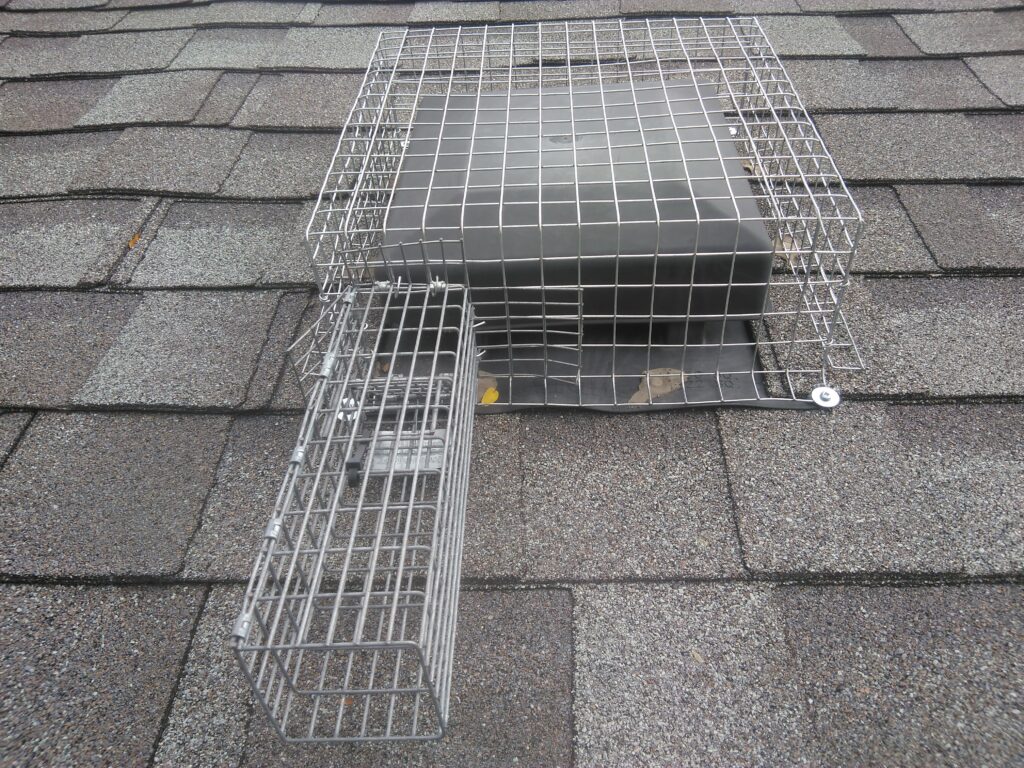
As part of this process, we install our one-way door system.
These doors allow adult squirrels to exit your home—but they cannot get back in.
It’s humane, effective, and permanent when paired with full sealing and prevention work.
Why One-Way Doors Matter In Humane Wildlife Removal
One-way doors are the foundation of humane squirrel removal.
Instead of trapping or relocating wildlife (which can cause stress and survival issues), we allow squirrels to leave naturally.
Here’s why this matters:
- Squirrels know the local food sources.
- They know shelter areas.
- They know predator risks.
- They know the territory.
Forcing relocation disrupts survival patterns. Humane wildlife control focuses on exclusion, not displacement.
After baby squirrels are safely removed and reunited with their mother, we:
- Install one-way doors over active entry holes.
- Identify all secondary vulnerabilities.
- Seal potential access points.
- Reinforce weak rooflines and soffits.
- Clean and restore contaminated insulation when necessary.
Our Baltimore team sees this every week—especially in neighborhoods near parks like Patterson Park, Druid Hill Park, and along tree-lined communities in Roland Park and Mount Washington.
Urban wildlife thrives where trees and buildings overlap.
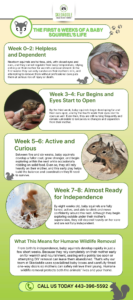
The First 8 Weeks Of A Baby Squirrel’s Life
When baby squirrels are born, they aren’t the fluffy, lively animals most people imagine. Instead, these little wild mammals arrive helpless, blind, and hairless, weighing only a few grams — sometimes around the weight of a couple of coins. At this stage, they’re entirely dependent on their mother for warmth, food, and survival. (Werdaan Blog)
Understanding their early development helps homeowners see why humane wildlife removal must be timed and handled carefully.
Week 0–2: Helpless and Dependent
Newborn squirrels are born without fur, their eyes and ears closed, and with no ability to regulate body temperature. Their skin is typically pink, and they rely completely on their mother for heat and nourishment.
During these first weeks, they also cannot digest solid food — only the nutrient-rich mother’s milk will sustain them. Attempting to handle or remove these babies at this stage without professional care puts them at high risk of stress, injury, or death.
Week 3–4: Fur Begins and Eyes Start to Open
By the third week, baby squirrels begin growing a thin layer of fur, and their ears start to open. Around the fourth week, their eyes begin to open too, giving them the first glimpse of the world around them. (Biology Insights)
At this point, they’re still nursing constantly and are not yet ready for independent life outside the nest. They remain vulnerable to temperature extremes and separation from the mother.
Week 5–6: Active and Curious
Between five and six weeks, their coat fills in, and baby squirrels start to resemble miniature adults. They begin exploring a bit within the nest, and their limbs grow stronger. Around this age, they may start nibbling on solid foods, but they still depend largely on their mother for milk and guidance.
This early play and exploration aren’t just cute — they’re vital for developing balance, coordination, and foraging skills.
Week 7–8: Almost Ready for Independence
By eight weeks old, most baby squirrels are fully furred and becoming increasingly active. They can climb, squat, and maneuver around the nest with confidence. While they begin exploring outside the nest under their mother’s supervision, they’re not fully independent yet and still rely heavily on maternal care. (PetShun)
Most baby squirrels wean between 8 and 10 weeks, after which they slowly transition into a diet of solid food and start preparing for life on their own.
What This Means for Humane Wildlife Removal
Eastern gray squirrels — the species most commonly found in Baltimore and surrounding Maryland communities — typically have 1–2 litters per year, with babies born in late winter/early spring and again in late summer. (Wikipedia)
From birth to independence, baby squirrels go through intense developmental changes in just a few short weeks. Because they are so dependent early on — especially for warmth and nourishment — sealing up entry points too soon or attempting to remove them yourself can leave them abandoned and unable to survive. This is exactly why our team at Skedaddle uses specialized baby boxes and carefully timed one-way doors to ensure the mother can return and retrieve her young safely.
By appreciating this rapid and delicate growth process, you can see why timing, protection, and professional care are essential. Humane wildlife removal isn’t just about getting animals out of your attic — it’s about doing it in a way that protects their lives and your home.
Squirrels In Maryland: By The Numbers
Let’s look at some key statistics that show why squirrel removal is such a common service in Maryland.
| Squirrel Facts | Data |
|---|---|
| Average litter size | 2–4 babies |
| Litters per year | 2 |
| Peak birthing months | Feb–April & Aug–Sept |
| Average lifespan (urban) | 5–7 years |
| Chewing force | Strong enough to damage wood & wiring |
| Common entry points | Roof vents, soffits, fascia gaps |
According to wildlife studies across the Mid-Atlantic region:
- Gray squirrel populations are highest in suburban and urban areas.
- Attic nesting increases during colder winters.
- Homes with overhanging tree branches are significantly more likely to experience intrusion.
Smart Squirrel Prevention Tips Every Baltimore Property Owner Should Know
Preventing squirrels from getting into your home is far easier—and far less expensive—than removing them once they’ve moved in. In Baltimore, we see most squirrel entry points located near the roofline. That’s because squirrels are exceptional climbers and prefer elevated access points where soffits, fascia boards, and roof vents are located.
The good news? A few proactive steps can dramatically reduce your risk.
Trim Back Overhanging Branches
Squirrels nearly always enter homes close to the roofline. Tree limbs that extend over or near your house act like highways straight to your attic.
What we recommend:
- Trim all branches to at least 6 feet away from the roof and exterior walls.
- Pay special attention to branches hanging directly over dormers or roof valleys.
- Inspect trees twice per year—especially before spring and fall breeding seasons.
Important detail: Even if branches are trimmed, squirrels can still climb certain building materials. Brick, rough-cut siding, and textured surfaces are easy for them to scale. Smooth, painted surfaces and aluminum siding are more difficult—but not impossible. That’s why trimming alone isn’t enough; it should be part of a broader prevention strategy.
Reduce Food Sources in Your Yard
Squirrels are opportunistic feeders. If your property provides a steady food supply, you’re increasing the chances they’ll explore your roof next.
Here’s how to make your yard less inviting:
- Avoid open bird feeding.
- Use properly designed squirrel-proof feeders.
- Install cone-shaped sheet metal guards on single-post feeders.
- Ensure feeders are at least 5 feet off the ground.
- Position feeders so squirrels can’t jump onto them from nearby trees or structures.
We often remind Baltimore homeowners that even well-intentioned backyard bird feeding can unintentionally support squirrel nesting nearby. If squirrels become comfortable feeding on your property, they may start investigating your attic for shelter—especially during colder months.
Clean Up Nuts and Natural Food Debris
Acorns, walnuts, and other nuts are prime squirrel food sources. In neighborhoods with mature oak trees—like Roland Park, Guilford, or Mount Washington—fallen acorns are common.
Regular yard maintenance makes a difference:
- Rake up fallen acorns and nuts.
- Dispose of them promptly.
- Keep small yards clear to reduce digging behavior.
Squirrels typically don’t carry acorns far to bury them. If they’re digging in your lawn, it’s often because the food source is already there. Removing it reduces both feeding activity and nesting interest nearby.
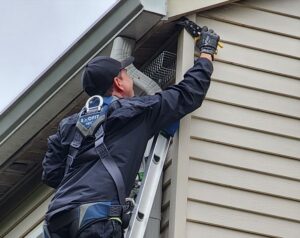
Seal Vulnerable Areas Before They Become Entry Points
Even with food sources reduced and branches trimmed, structural vulnerabilities can still allow access.
During professional inspections in Baltimore homes, we commonly find:
- Gaps along soffits
- Loose fascia boards
- Damaged roof vents
- Open construction joints
Preventative sealing by wildlife professionals ensures squirrels cannot chew or pry their way inside. Because squirrels have strong teeth and persistent behavior, sealing must be done with durable materials—not temporary patches.
Why Prevention Matters More Than Removal
Prevention isn’t just about avoiding noise in your attic. Squirrels can:
- Chew electrical wiring (a real fire risk)
- Damage insulation
- Create contamination issues
- Compromise ventilation systems
A proactive approach protects your property, reduces stress, and eliminates the risk of dealing with baby squirrels during breeding season.
At Skedaddle, our humane wildlife control process always includes a full property assessment—not just removal. We identify the weak spots squirrels look for and reinforce them properly. That’s how we deliver long-term results backed by our lifetime guarantee.
If you’re unsure whether your Baltimore home is vulnerable, scheduling an inspection before breeding season begins can save you significant time and expense later.
Common DIY Mistakes That Make Things Worse
We’re going to be honest—most of our emergency calls start with a well-intentioned DIY attempt.
Here are the most common mistakes we see:
- Sealing entry holes too soon
If babies are still inside, the mother will find another way in. - Using store-bought deterrents
Ultrasonic devices and sprays rarely work long-term. - Ignoring attic contamination
Squirrel droppings and urine can damage insulation and create odor issues. - Climbing onto the roof without safety equipment
Falls are one of the most common homeowner injuries.
Wildlife removal is not just about removing animals. It’s about understanding behavior, breeding cycles, building construction, and safety protocols.
It’s specialized work.
We Handle More Than Squirrels In The Baltimore Area
While this blog focuses on baby squirrels, our team handles a wide range of wildlife removal situations throughout Baltimore and surrounding communities.
We regularly provide humane removal for:
- Raccoons
- Skunks
- Bats
- Birds
- Rats and mice
Homes near wooded areas or waterfronts—like those close to the Inner Harbor or Gwynns Falls—often experience raccoon and bat activity while skunks are more common near open green spaces and commercial properties.
Our approach is always the same:
Our lifetime guarantee ensures that if wildlife re-enters through a repaired area, we return to fix it at no additional cost. That’s peace of mind you can’t get from DIY patch jobs.
You can learn more about our lifetime guarantee here:
https://www.skedaddlewildlife.com/wildlife-control-lifetime-guarantee/
A Real Look At What Humane Wildlife Control Feels Like
When homeowners call us, there’s usually frustration in their voice. Sometimes embarrassment. Often stress. They’re worried about damage, noise, and what’s happening inside their walls. We’ve been serving communities like Baltimore long enough to understand that wildlife problems don’t just affect structures—they affect peace of mind.
There’s a moment during baby squirrel removals that always stands out. When we place the baby box in a shaded area and step back, the property gets quiet. We monitor from a distance. The mother approaches cautiously, assesses the situation, and begins moving her young one by one. It’s efficient. It’s instinctual. And it works.
This is the difference between reactive wildlife control and humane wildlife removal. We work with natural behavior instead of fighting against it. That philosophy protects the animals, your home, and your long-term investment.
FAQs About Squirrels In Baltimore
How do I know if there are baby squirrels in my attic?
If you hear high-pitched chirping along with scratching sounds during Maryland’s spring or late summer months, babies may be present. A professional wildlife removal inspection can confirm nesting activity safely without disturbing the family.
Is humane squirrel removal more effective than DIY methods?
Yes. Humane wildlife removal using one-way doors ensures squirrels leave naturally and cannot re-enter. DIY squirrel removal often leads to property damage, incomplete sealing, and repeat infestations.
hat happens after squirrel removal is complete?
After the mother relocates her babies and one-way doors are removed, we fully seal entry points and repair vulnerabilities. Our lifetime guarantee ensures long-term protection for your Baltimore home or business.
Keep Your Home And Family Safe With Skedaddle
Protecting baby squirrels while removing them from homes is one of the most important parts of what we do. It reflects our commitment to humane wildlife control and responsible service in Baltimore.
If you’re dealing with scratching sounds, roof damage, or attic activity, don’t wait. The longer wildlife remains inside a structure, the more complicated the removal becomes. We use proven one-way door systems, protective baby boxes, and full exclusion techniques backed by our lifetime guarantee.
Explore more of our blog for practical homeowner advice, prevention tips, and behind-the-scenes insights from our wildlife control experts. If you suspect squirrels have taken up residence in your home, contact our professionals today! Skedaddle is standing by and ready to make your home safe for your family.
When wildlife moves in, we make sure they move out—safely, humanely, and for good.

 Loading...