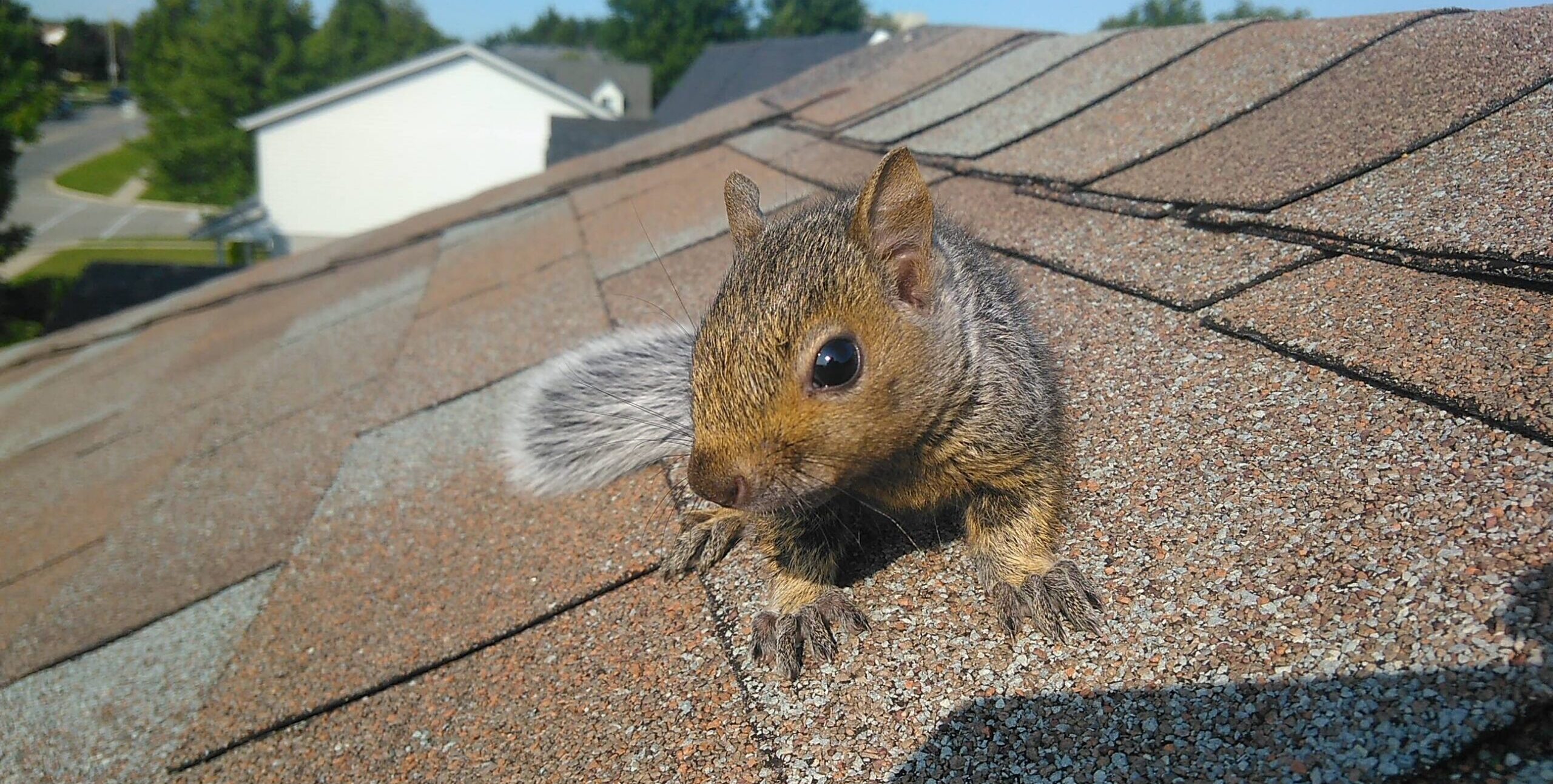
You might think the trees in your yard are just part of the scenery. But to a squirrel, every branch that hangs near your roofline is a direct path onto your home. Surrey’s mature neighbourhoods are full of tall trees, steep lots, fences, and hydro lines and all of it gives these creatures easy access to your roof, your soffits, and eventually your attic.
Summer is when the problem peaks. Squirrels are raising their young, actively scouting for secure nesting spots, and testing every weak point on your roofline on a daily basis. You might not notice it happening until you hear scratching in the attic or spot damage along the roof edge and by then, they’ve usually been inside for a while.
At Skedaddle Humane Wildlife Control in Surrey, we see this pattern every summer across the city’s older and newer neighbourhoods alike. In this blog, we explain exactly how squirrels get easy access to rooflines in Surrey, what they do once they’re up there, and how our team finds every entry point and closes it off for good.
How Do Squirrels Get Into Attics?
Squirrels get into attics by using the trees, fences, hydro lines, and other structures around your home to reach the roofline, and then chewing or pushing through weak spots to get inside. The most common entry points are damaged roof vents, gaps along the soffit, worn fascia boards, and spots where roofline materials meet and have shifted over time. They don’t need a large opening – a gap the size of a golf ball is enough.
What makes Surrey homes especially vulnerable is the combination of mature tree canopy and the variety of structures that give squirrels a path to the roof without ever touching the ground. Hydro lines run right past rooflines. Fences sit close to siding. Overhanging branches hang within jumping distance of soffits and vents. Once they’re up there, they walk the full perimeter of the roof looking for any weak spot they can use.
The chewing doesn’t stop once they’re inside. Their front teeth never stop growing, which means they gnaw constantly on wood framing, insulation, and wiring. This is what makes an attic intrusion so damaging, and why calling our team as soon as you notice something is always the right move. The sooner we get in, the less damage there is to deal with.
Mature Trees: The Most Direct Route to Your Roof
Surrey’s tree canopy is one of the things that makes the city’s neighbourhoods so appealing. Mature maples, oaks, cedars, and firs line streets across the city, and in established areas those trees have grown large enough that their branches extend well over rooftops. For squirrels, that canopy is a highway – a connected network of branches that lets them travel across entire neighbourhoods without touching the ground.
A branch that hangs within two to three metres of your roofline is close enough for a squirrel to jump from. They’re powerful leapers and can cover that distance easily, landing directly on your roof or soffit edge. Once they’ve made that jump once, they use the same route every day, testing the roofline on every visit and returning to any weak spot they’ve found.
The trees don’t have to be on your property to be a problem. A neighbour’s overhanging branch that reaches toward your roof gives squirrels just as much access as a tree in your own yard. Our team looks at every tree and branch near your roofline during the inspection — not just what’s on your property, but everything in the immediate area that could be giving them a path onto your home.
Hydro Lines and Utility Cables: Tightropes to Your Roofline
Hydro lines and utility cables run through almost every residential neighbourhood in Surrey, and to a squirrel they’re essentially a tightrope that connects trees to rooftops. These creatures are agile and confident on narrow surfaces, and they use power lines and cable runs to bypass the ground entirely and travel directly to the point where the lines meet your home.
Where a hydro line attaches to your house is one of the spots our team checks first during an inspection. The area around the attachment point often has small gaps or worn materials where the line enters the structure, and these gaps are a common starting point for chewing and entry. A squirrel that travels a hydro line to your roofline is already at one of the most vulnerable spots on your home’s exterior.
Here’s what our team looks for when assessing hydro line and utility cable access on Surrey properties:
- Where Lines Attach to the Exterior Wall or Roofline: The attachment point is often surrounded by small gaps in the cladding or soffit that provide a starting point for chewing. These spots are easy to miss during a visual inspection from the ground but are one of the most consistent entry zones our team finds on Surrey homes. We check every utility attachment point as part of the full exterior inspection.
- Lines That Run Close to Gable Vents or Roof Edges: A hydro line that passes within a metre of a gable vent or roof edge gives squirrels a direct path to one of the most vulnerable spots on your home. Gable vents with plastic or aluminum covers are easy to chew through, and a squirrel that arrives via a utility line is already positioned right next to them. Our team replaces compromised vent covers with heavy-gauge steel as part of the exclusion process.
- Cable Runs That Drop Down Along the Siding: Utility cables that run vertically along your home’s siding give squirrels a climbing surface that takes them directly up the exterior wall to the soffit edge. Once they reach the soffit, they test it for gaps and weak points on every visit. Our team checks the full length of any cable run along the exterior and assesses the soffit condition in those areas closely.
Steep Lots, Fences, and Elevated Ground
Surrey’s topography is varied – some neighbourhoods sit on relatively flat ground, while others have steep lots where the grade of the land brings certain parts of the roofline much closer to the ground than on a flat property. On a steep lot, the back of a home’s roofline may be accessible from ground level or from a fence or retaining wall that sits right next to it. This dramatically reduces how much effort it takes to reach the roof.
Fences are one of the most overlooked access routes our team finds during Surrey inspections. A wooden or chain-link fence that runs close to the side of your home gives squirrels a vertical boost that puts them at soffit height quickly. From the top of a fence, the jump to a soffit edge or roof overhang is often short enough to make without much effort at all.
Here’s what our team looks for when assessing fence and lot-related access routes:
- Fences That Run Close to the Siding or Soffit: A fence that sits within a metre or two of your home’s exterior wall is close enough to act as a launch point to the soffit or roof edge. These are especially common on narrow lots where the fence line runs right along the side of the house. Our team notes every fence and structure near the home during the inspection and factors them into the full access picture.
- Retaining Walls That Raise Ground Level Near the Roofline: On steep Surrey lots, retaining walls can bring the effective ground level high enough that the rear roofline is within easy reach. This is one of the most direct access routes our team finds on hillside properties, and it’s often not obvious until you look at the grade of the land from a specific angle. We assess the full exterior of every property with this in mind, not just the front-facing roofline.
- Sheds and Garages That Act as Stepping Stones: A shed or detached garage that sits close to the main house gives squirrels an intermediate structure to climb before jumping to the main roof. They’re comfortable moving across rooftops and will use a lower structure to reach a higher one without hesitation. Our team checks every outbuilding on the property and assesses whether it’s being used as part of the access route to the main home.
Vines, Downspouts, and Climbing Surfaces
Not every access route involves a tree or a fence. Some of the most common climbing surfaces our team finds on Surrey properties are the ones attached directly to the home – downspouts, decorative vines, and trellises that give squirrels a built-in ladder straight up the exterior wall to the roofline.
Ivy and other clinging plants that grow up the side of a home create a dense climbing surface that’s easy to grip and almost impossible to deter once it’s established. A vine that reaches the soffit level gives squirrels direct access to the underside of the roof overhang, which is one of the most common places our team finds entry points. The plant itself doesn’t cause the damage; it’s the access it provides that creates the problem.
Downspouts are another surface that gets used more than homeowners expect. The corrugated texture of a metal downspout gives squirrels enough grip to scale it quickly, taking them from ground level to the eavestrough and soffit edge in seconds. Our team checks every downspout and climbing surface on the exterior during the inspection and flags anything that’s providing easy rooftop access.
What They Do Once They Reach the Roofline
Getting onto your roof is only the first step. Once squirrels are up there, they walk the full perimeter looking for any weak spot they can use to get inside. They test soffits, vents, and roof edge materials on every visit, and they return to the same spots repeatedly until they find a way through. Here’s what our team most commonly finds when they’ve been working on a roofline:
- Chewed or Damaged Roof Vents: Plastic and aluminum vent covers are easy to chew through or pull away from the frame. Bathroom, kitchen, and dryer exhaust vents are especially common targets because they push warm air outside, which signals to squirrels that there’s a warm, sheltered space on the other side. Our team replaces all damaged vent covers with heavy-gauge steel versions that can’t be chewed through.
- Gaps Along the Soffit and Fascia: Where the soffit meets the fascia or roofline, small gaps often open up as a home ages and materials shift. These gaps are a direct path into the attic and are one of the most common entry points our team finds during Surrey inspections. Many of them can’t be seen from the ground, but our team knows exactly where to look and what to check.
- Worn or Rotted Fascia Boards: Surrey’s wet winters and humid summers cause fascia boards to soften over time, especially where eavestroughs have been clogged and water has backed up against the wood. A softened fascia board takes very little effort to chew through, and once it’s been breached the opening can be widened quickly. Our team replaces damaged fascia material and seals the area with durable materials as part of the full exclusion process.
Squirrel Removal and Prevention with Skedaddle
When our team arrives at your Surrey home, we start by checking the full outside of the property. We look at the roofline, every vent, the soffit edges, the fascia, and every tree, fence, hydro line, and structure nearby that could be giving them a path to the roof. We check for spots where they’re already getting in and spots that could become entry points soon if they’re not dealt with.
Our removal process uses one-way door systems at every active entry point. These let them leave the attic on their own but stop them from getting back in. Once all the activity has stopped and our team has confirmed the attic is empty, we seal every opening with strong steel and durable materials that hold up against chewing and bad weather.
All cleanup of droppings, nesting material, and damaged insulation is done entirely by our team. You should never go near any of this without the right protective gear, so don’t touch it, and don’t go into the attic on your own. If you hear scratching or thumping above you, call us right away and stay out of the area until we arrive.
Summer Squirrel Challenges in Surrey
Surrey has a lot of mature trees, steep lots, and established neighbourhoods and all of that makes it easier for squirrels to reach rooftops across the city. Areas like Cloverdale, South Surrey, and Newton have large, older trees on almost every block that give them a direct jump onto rooflines. Add in the fences, hydro lines, and climbing surfaces that are common in Surrey’s older areas, and there are a lot of ways to get onto a roof without much effort.
Surrey’s wet weather also makes things worse. All the rain the region gets softens fascia boards, breaks down vent covers, and causes gaps to open up along the soffit over time. By the time summer arrives, those weak spots are ready to be found, and squirrels that have been active all spring will find them fast once nesting season starts up again.
Summer is the busiest time of year for squirrel calls across Surrey, with the most activity happening from June through August. This is when the second breeding season pushes mothers to look for safe, warm attic spaces to raise their young. Our team responds to calls all across Surrey year-round and knows the specific routes and weak spots that drive this kind of activity in different parts of the city.
Frequently Asked Questions
How do I know if a squirrel is getting onto my roof regularly?
Common signs include scratching or scurrying sounds in the attic during the day, chew marks or debris along the soffit edge, and worn or damaged vent covers on the roof. You may also notice them running along your fence line or hydro lines toward your roofline. If you see this regularly, call our team for an inspection.
Can squirrels get in through a vent that looks undamaged from the ground?
Yes. Vent covers that appear intact from the ground can have small chew marks, pried edges, or gaps around the frame that aren't visible without a close inspection. Our team gets up to roof level during every inspection to check each vent properly rather than relying on a ground-level assessment.
Do squirrels use the same entry point every time?
Yes. Once they've found a reliable entry point, they use it consistently and return to it day after day. This is why proper sealing after removal is so important. Patching a gap temporarily won't stop an animal that knows exactly where it's going. Our team seals every entry point with materials that hold up long-term.
How quickly can squirrels cause damage once they're in the attic?
Damage begins immediately. They chew on wiring, tear apart insulation for nesting material, and leave behind waste that builds up over time. The longer they're in the attic, the more extensive the damage becomes. Chewed wiring is a fire hazard and should be assessed by a licensed electrician after our team completes the removal.
Why do I keep having squirrel problems at the same house every year?
Once a squirrel has successfully nested in your attic, it and its offspring remember that location and return to it. Unless every entry point is properly sealed with materials that resist chewing, the same property will be targeted year after year. Our team seals every opening we find, not just the main entry, to break that cycle permanently.
If They Can Reach Your Roof, They Can Reach Your Attic
Squirrels don’t need much – a branch close enough to jump from, a fence that runs near your siding, or a hydro line that drops them right at your soffit edge. Surrey’s mature trees, steep lots, and dense neighbourhoods give them plenty of options, and they use all of them. Once they’re on your roof, the weak spots are easy to find and the damage starts fast.
Most homeowners don’t realize how many access routes exist around their home until our team points them out during an inspection. By then, the squirrels have often been using those routes for weeks. The sooner we assess the full picture, the sooner we can close every path they’re using and make sure they can’t come back.
At Skedaddle Humane Wildlife Control in Surrey, we handle everything from the first inspection to the final seal. Our team finds every entry point, removes any squirrels using our one-way door system, and closes off your home permanently with materials built to hold. You don’t need to do a thing except call us. Request an estimate today and let our team take care of the rest.

 Loading...







