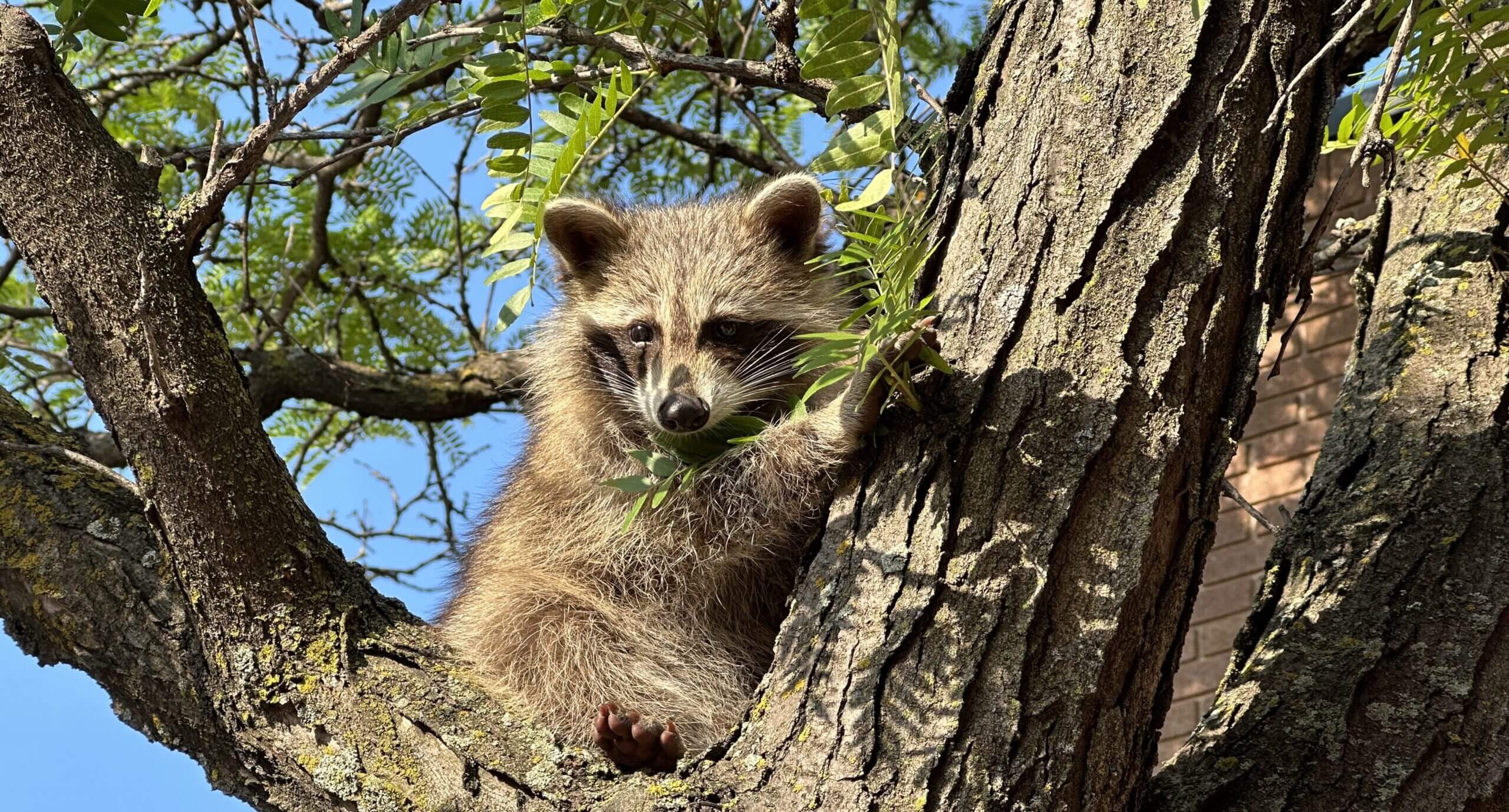
Have you ever stood in your yard, watching the astonishing sight of a raccoon perched confidently on your roof? If you’re a Milwaukee resident, this scene is not uncommon. Raccoons, with their remarkable climbing abilities, frequently navigate rooftops across the city.
At Skedaddle Humane Wildlife Control, we’ve invested over three decades in understanding these creatures and developing strategies to prevent them from making themselves at home in your attic.
Raccoon Climbing Abilities: Masters of Vertical Ascent
Raccoons are naturally equipped with unique physical traits that make them exceptional climbers. Understanding these abilities is key to understanding the challenge of keeping them off your roof.
The Physical Advantages of Raccoons
Raccoons have several physical attributes that contribute to their impressive climbing abilities:
- Dexterous front paws: Boasting nimble front paws with five long fingers, raccoons can grasp objects and manipulate fasteners similarly to human hands. This capability allows them to maintain a firm grip on various surfaces.
- Sharp claws: Their semi-retractable claws provide excellent traction on rough surfaces like tree bark, brick walls, and asphalt shingles.
- Strong limbs: Despite their somewhat pudgy appearance, raccoons possess powerful leg muscles, enabling them to pull themselves up vertical surfaces with relative ease.
- Flexible ankles: Raccoons have specialized ankle joints that can rotate 180 degrees, allowing them to descend trees and walls headfirst and enhancing their climbing versatility.
Their climbing technique combines these attributes seamlessly. As they scale a vertical surface, raccoons use their front paws to grasp higher points, pushing upward with their hind legs, allowing them to climb surfaces that would be challenging for many other animals.
Common Pathways Raccoons Use to Access Your Roof
To understand how raccoons climb roofs, it’s essential to know the routes they typically use to reach your home’s highest points. In urban and suburban neighborhoods, there are multiple potential pathways for them to take advantage of.
- Trees overhanging the roof: Trees with branches extending over or near your roof act as convenient bridges for raccoons, allowing them to climb the trunk and traverse branches without touching the ground.
- Adjacent structures: Buildings, sheds, or garages near your home serve as stepping stones. Raccoons can climb one structure, jump across small gaps, and continue their journey upward.
- Downspouts and gutters: These vertical channels are ideal climbing surfaces for raccoons. Metal seams and brackets offer perfect gripping points for their claws.
- Lattice, trellises, and vines: Garden structures and vegetation growing along exterior walls create natural ladders quickly exploited by raccoons.
- Corner edges of buildings: The corners where two walls meet form a chimney-like situation, allowing raccoons to brace themselves as they climb upward.
Raccoons possess excellent spatial memory and problem-solving skills. Once they discover a successful path to your roof, they’re likely to return by the same route repeatedly, possibly with friends or offspring in tow.
Why Urban Environment Makes Roof Access Easier for Raccoons
Milwaukee’s characteristics create an ideal environment for raccoons seeking elevated shelter, much like how the Milwaukee Art Museum’s wings reach unexpected heights.
Milwaukee’s Raccoon-Friendly Features
- Mature tree canopy: The city’s established neighborhoods have tall trees providing direct roof access. While Milwaukee’s commitment to urban forestry benefits many, it also creates natural highways for raccoons.
- Older housing stock: Historic neighborhoods feature homes with architectural details conducive to climbing:
- Decorative trims and moldings
- Textured brick or stone exteriors
- Multiple roof levels and dormers
- External drainage systems
- Water proximity: Milwaukee’s location along Lake Michigan and presence of rivers provides abundant water sources, attracting raccoons to urban areas where they then seek shelter in homes.
- Food availability: Urban raccoons find plenty of food sources—garbage bins, pet food left outside—supporting larger raccoon populations close to our homes.
Roof Raccoon Entry Points: Vulnerabilities Raccoons Exploit
Once raccoons reach your roof, they’re in search of entry points into your attic. Knowing the vulnerabilities they exploit can help protect your home.
Common Roof Vulnerabilities
- Soffit intersections: Gaps often develop where different soffit sections meet, which raccoons can enlarge.
- Roof vents: Vents for plumbing and attic ventilation often have metal or plastic covers, which raccoons can tear through.
- Chimney openings: Uncapped chimneys are direct access routes into your home for climbing raccoons.
- Deteriorated roof materials: Aging or damaged shingles, especially near eaves, offer spots raccoons can tear apart to create openings.
- Construction gaps: Spaces between different roofing materials or around additions often have small gaps raccoons can exploit.
A determined raccoon can turn a small vulnerability into a raccoon-sized entry hole in just 30 minutes. Their strong paws and teeth make quick work of many materials.
Expert Strategies for Raccoons on Roof Prevention
Now that you know how raccoons climb roofs and enter attics, let’s delve into effective prevention techniques. At Skedaddle, we’ve honed comprehensive strategies from decades of wildlife control experience.
Creating a Raccoon-Proof Perimeter
Tree management:
- Keep tree branches at least 10 feet from your roofline.
- Consider metal bands around tree trunks to impede climbing.
- Remove dead trees for prevention.
Structural modifications:
- Install smooth metal flashing around downspouts to deter climbing.
- Secure lattice and trellises away from potential climbing access.
- Implement angled metal guards at building corners.
Entry point protection:
- Use quality chimney caps that withstand wildlife attempts.
- Reinforce roof vents with heavy-gauge metal screening.
- Timely inspect and repair soffit vulnerabilities.
Additional prevention tips:
- Ensure trash is in animal-proof containers.
- Avoid leaving pet food outside overnight.
- Utilize motion-activated lights near potential routes.
Professional Prevention Solutions
While DIY efforts can aid in prevention, enlisting professional wildlife control specialists brings invaluable expertise and equipment. Our Skedaddle technicians offer comprehensive property assessments to uncover potential vulnerabilities often missed by homeowners.
Our approach includes:
- Thorough inspection of your entire roofline and potential access routes.
- Identification and repair of existing entry points and vulnerable areas.
- Installation of professional-grade exclusion materials.
- Custom protection solutions tailored to your home’s architecture.
- Ongoing maintenance recommendations.
The Impact of Ignoring Raccoon Roof Access
Ignoring raccoon access to your roof can lead to significant damage and risks, emphasizing the importance of prevention.
Potential Damages and Risks
Structural damage:
- Torn insulation reduces energy efficiency.
- Chewed wiring poses fire hazards.
- Damaged HVAC ductwork impacts system efficiency.
- Soiled insulation might need full replacement.
Health concerns:
- Raccoon droppings may contain Baylisascaris roundworm, posing a significant health risk.
- They can carry diseases like leptospirosis and rabies, raising safety concerns.
By taking proactive measures to keep raccoons off your roof, you ensure a safe environment for your family and avert costly repairs. If raccoons are already a concern or if you want to safeguard your property, contact Skedaddle today. Our team of wildlife control experts is ready to protect your home with professional, humane, and effective solutions. Your peace of mind and home’s safety are just a call away.

 Loading...







