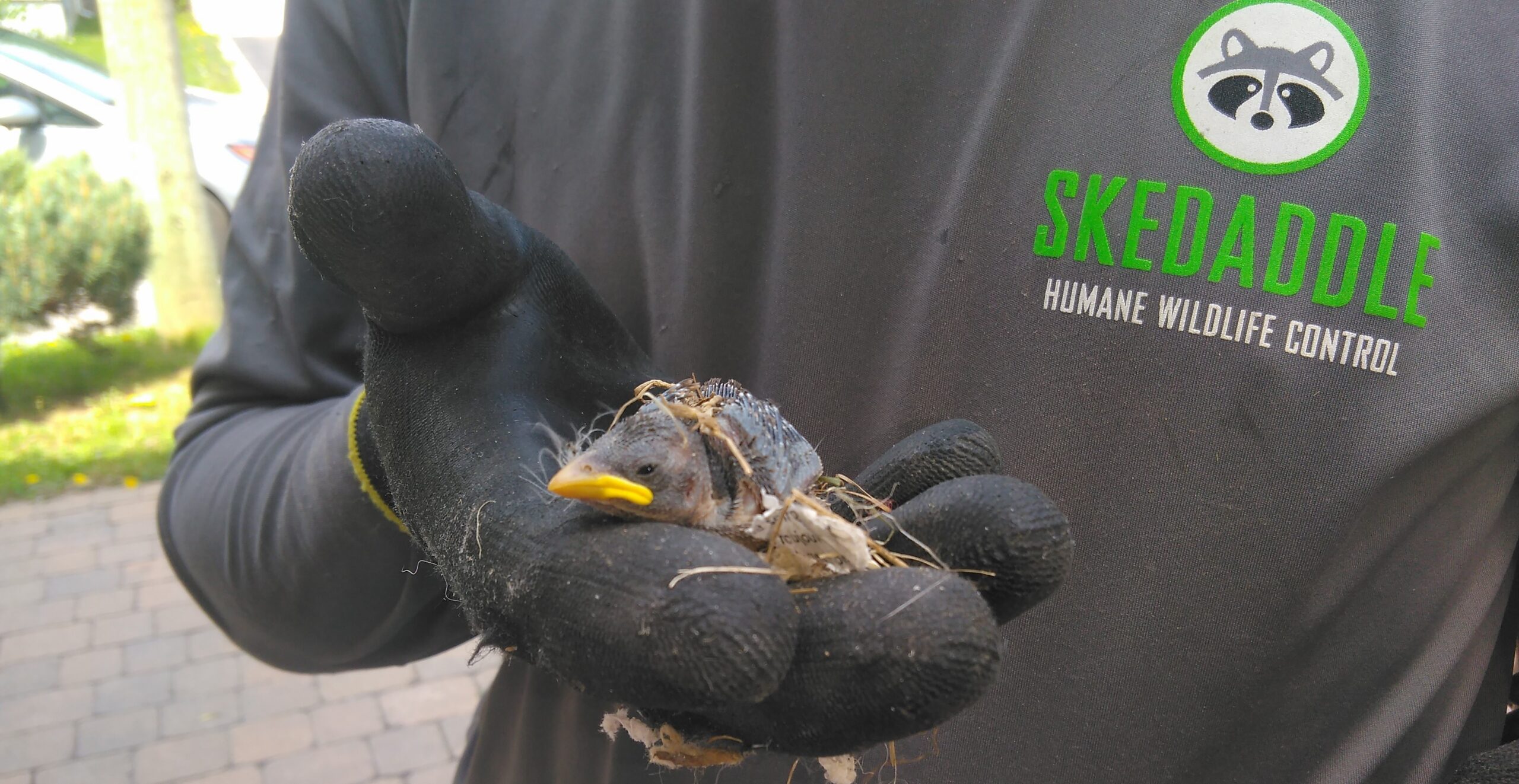
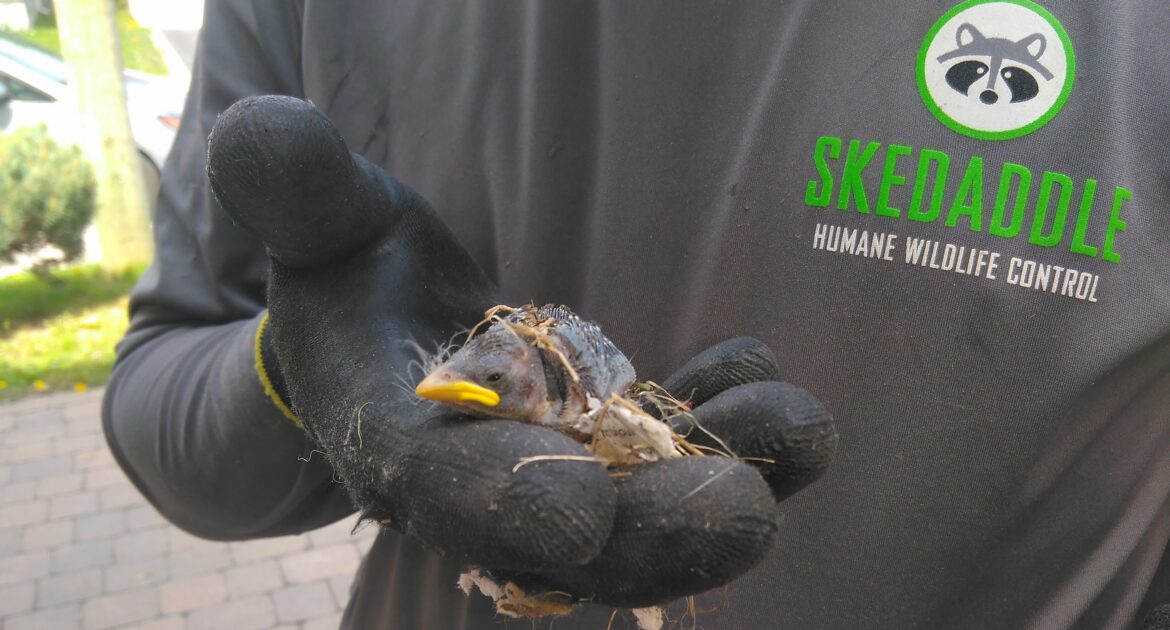
It’s a peaceful spring morning. You are enjoying your coffee on the deck when you hear a soft chirping sound coming from the dryer vent. When you look closer, you spot a small beak poking out.
In an instant, your quiet morning turns into a concern. You may feel the urge to help or clear out the nest, but stopping to think before acting is the best first step.
When baby birds are nesting in a home, the safest choice is usually to leave them alone and seek our professional guidance. Trying to remove them yourself can harm the birds and may even break baby-bird-nest-removal laws. This is why many homeowners turn to us at Skedaddle Humane Wildlife Control in Hamilton, where our trained professionals understand how to handle nesting birds safely and legally.
In this blog, we explain why removing baby birds on your own is not recommended, what the safest options are, and how our professional wildlife control helps protect both your home and the animals.
Why You Shouldn’t Remove Baby Birds Yourself
Finding a nest in your home can feel like an invasion of privacy. You might worry about the noise, the smell, or damage to your property. However, rushing to take matters into your own hands is rarely the right solution. There are several important reasons why you should leave the nest alone and call for our professional help instead.
It Could Be Illegal
One of the biggest reasons to avoid touching a bird nest is the law. In Canada, many bird species are protected under the Migratory Birds Convention Act. This law makes it illegal to disturb, damage, or destroy the nests and eggs of migratory birds without a special permit.
- Protected Species: Most birds you see in your backyard, like robins and sparrows, are likely protected.
- Legal Consequences: Disturbing an active nest with eggs or chicks can lead to fines or legal trouble.
- Permits Required: Only professionals like us with the right permits are allowed to manage these situations legally.
It is very difficult for the average homeowner to know which birds are protected and which are not. Assuming the nest is protected is always the safest bet. By waiting or calling us, you avoid breaking baby bird nest removal laws and keep yourself out of trouble.
You Might Hurt The Babies
Baby birds are incredibly fragile. Their bones are tiny, and their bodies are not strong enough to handle being moved around. Even if you are trying to be gentle, you could accidentally injure them.
- Delicate Bodies: Picking up a chick can cause internal injuries or broken wings.
- Temperature Sensitivity: Baby birds need specific warmth to survive; moving them away from the nest can cause them to get too cold very quickly.
- Stress: Handling wild animals causes them extreme stress, which can be fatal for young creatures.
Our team at Skedaddle Humane Wildlife Control has the training and tools to handle these delicate situations without causing harm. We know how to keep them safe and warm if they need to be moved for a short time during a professional exclusion.
Parents Might Abandon The Nest
Birds are devoted parents, but they can be scared off easily. If you mess with a nest or move it to a “better” spot, the parents may not recognize it or feel it is safe anymore.
- Location Matters: Parents choose a nesting spot for specific reasons like safety and shelter.
- Smell Myths: Contrary to popular belief, birds don’t have a strong sense of smell, so touching a baby won’t make the mom reject it. However, the disturbance itself is the problem.
- Fear Factor: Constant human activity near the nest can frighten the parents away for good, leaving the babies to starve.
If the parents abandon the nest, the chicks will not survive. It is best to minimize your presence and let the parents do their job until the babies are old enough to fly away.
It Can Be Dangerous For You
Climbing up a ladder to reach a vent or poking around in an attic isn’t just risky for the birds; it is dangerous for you too. Nests are often located in high, hard-to-reach places.
- Ladder Safety: Trying to balance on a ladder while holding a box or tool is a recipe for a fall.
- Health Risks: Bird droppings can carry diseases and parasites like mites that you don’t want on your skin or in your lungs.
- Defensive Parents: Some birds will swoop and dive at you if they feel their babies are threatened, which could cause you to lose your balance.
Your safety is important. Instead of risking a fall or illness, let our experienced technicians handle the dirty work. We have the safety gear and training to reach those tricky spots without getting hurt.
Understanding Baby Bird Nest Removal Laws
Baby bird nest removal laws exist to protect bird populations and keep ecosystems healthy. Even when homeowners mean well, disturbing a nest can interrupt a bird’s natural life cycle. That is why these laws are taken seriously.
In Canada, the Migratory Birds Convention Act protects the nests of many bird species. If a nest contains eggs or live young, it cannot be removed until the birds have fully left on their own. Some non-migratory birds may also be protected under provincial laws, such as Ontario’s Fish and Wildlife Conservation Act.
Exceptions are rare and usually apply only to invasive species, which can be hard to identify. If a nest creates a safety risk, like blocking a dryer vent, professional wildlife control is the safest option. Experts understand the laws and can handle the situation properly without putting homeowners at risk of breaking them.
The Problem With DIY Removal Methods
DIY bird removal methods often cause more problems than they solve. Blocking entry points too early can trap baby birds inside, leading to strong odours and damage as adult birds try to get back in. This creates a stressful and unhealthy situation for both the birds and the home.
Scare tactics like plastic owls or shiny objects rarely work. Birds quickly learn these are not real threats and return to nesting. Cleaning nests on your own can also be unsafe, as bird droppings may contain harmful bacteria or spores that should not be inhaled.
Most DIY fixes do not address why birds chose the spot in the first place. Without proper sealing and prevention, new nests often appear the following season.
When Is It Safe To Remove A Nest?
The safest time to remove a bird nest is when it is completely inactive. This means there are no eggs and no baby birds present. For most songbirds, the nesting cycle lasts about four to six weeks, after which the birds leave on their own.
Even when a nest looks empty, removal can still be risky. Old nests may contain parasites, and some birds reuse the same nesting spots. Nests found in fall or winter are more likely inactive, but birds may still use these spaces for shelter.
Because it is difficult to be certain a nest is abandoned and because of health risks, professional help is often the safest choice. Experts can confirm whether a nest is inactive and remove it properly, keeping the home clean and secure.
Removing Bird Nests Safely With Professionals
At Skedaddle Humane Wildlife Control, bird nest removal is handled carefully and responsibly. The goal is not only to remove birds safely, but also to protect the home from future problems. Each situation is different, which is why a professional process matters.
The first step is a detailed inspection of the roof, vents, soffits, and attic to find entry points and nesting areas. The bird species and nesting stage are identified to ensure the right approach is used. When possible, one-way doors are installed to allow birds to leave safely without returning. If nests must be removed, affected areas are cleaned and sanitized to remove debris and droppings.
Once activity stops, all access points are sealed with durable screening. This prevents birds and other wildlife from getting back inside and helps keep the home protected long-term.
Protect Your Home from the Birds
Sharing your home with nature is wonderful, but not when it’s inside your walls or vents. The chirping of baby birds is cute, but the damage and health risks they bring are real concerns. It is natural to want to solve the problem quickly, but rushing to remove a nest yourself can lead to legal trouble, injury to the animals, and safety risks for you.
By understanding baby bird nest removal laws and the dangers of DIY methods, you can make the responsible choice. Waiting a few weeks for the babies to grow or calling in experts ensures that protected bird species nesting in your home are treated with care.
If you are worried about birds in your vents or attic, don’t wait and worry. Let us handle the hard work for you. We have the experience and tools to get the job done right, keeping your home clean and the wildlife safe.
For peace of mind and a bird-free home, request an estimate from us at Skedaddle Humane Wildlife Control in Hamilton today. We are here to help you coexist with nature—on your terms.

 Loading...







