Lifetime Warranty
On workmanship and materials.
Skedaddle Ottawa — serving the greater Nepean area since 1993.
No traps. No poison. Permanent exclusion.
Nepean runs west and south from the Rideau River corridor to the National Capital Commission Greenbelt, and its mix of post-war Bells Corners streets, Meadowlands and Centrepointe infill, Craig Henry bungalows, and Barrhaven-adjacent edges gives wildlife steady access to soffits, roof vents, and foundation seams. Skedaddle Ottawa removes mice, raccoons, squirrels, and bats from Nepean homes using inspection-led humane exclusion matched to the species, seals every opening permanently, decontaminates wherever the animals were active, and restores attic insulation where it was damaged.
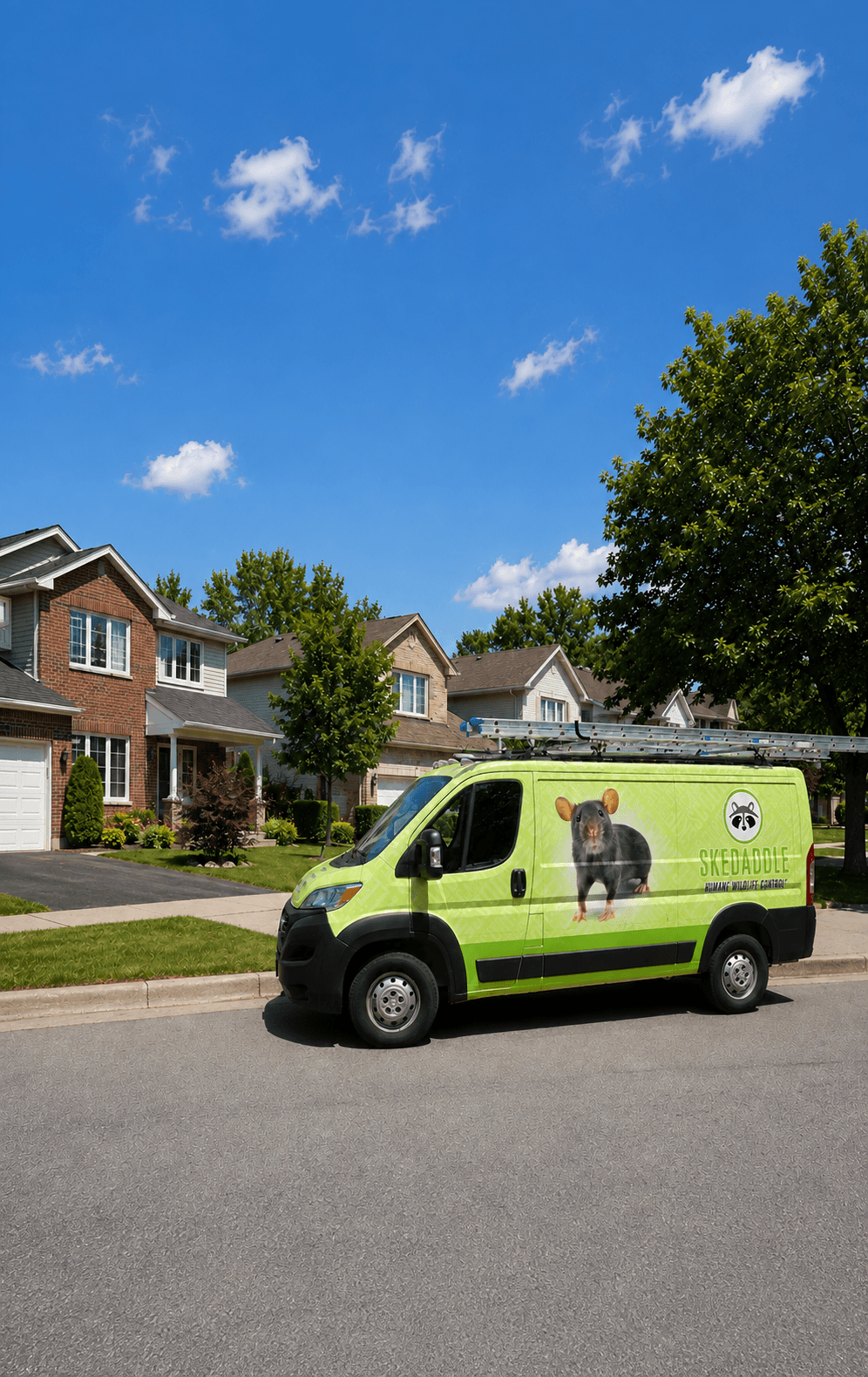
Most Nepean homeowners reach us after something has already started moving overhead or behind a wall. Three things decide how that ends: how well the crew knows this part of Ottawa, how its technicians are trained, and what stands behind the seal.
Skedaddle Ottawa has served the greater Ottawa area since 1993, and Nepean has been inside that territory from the beginning. The suburb reaches from the Rideau River corridor west to the Greenbelt, taking in Bells Corners, Bayshore, Meadowlands, Centrepointe, Craig Henry, and the Barrhaven-adjacent streets on its southern edge, and each pocket fails in its own way. Over the trailing twelve months the crew completed 110+ humane wildlife removals in Nepean, so when something is scratching above a Woodvale ceiling, a technician has usually solved the same puzzle a few streets away.
Skedaddle technicians are trained in wildlife biology, home repair, decontamination, and restoration, and they work with humane methods approved by SPCAs and Humane Societies. A Nepean appointment begins with identification: which species, which openings, and whether dependent young are tucked behind a soffit return or inside a wall void. The method is then chosen to suit the animal and the building, and nothing is trapped, poisoned, or left for a bait station to finish. Bat colony work is planned around Ontario MNR guidance, which advises leaving a roost undisturbed from mid-May to mid-August while pups cannot fly.
Every full exclusion Skedaddle Ottawa completes in Nepean carries a lifetime guarantee on all workmanship and materials. If anything gets back in through an opening we sealed, the crew returns and re-seals it at no charge. Before work starts, the homeowner receives a written scope itemizing exclusion, decontamination, restoration, and guarantee terms, so a Parkwood Hills bungalow owner and a Centrepointe townhouse owner both know exactly what they are buying. Skedaddle Ottawa's work is insured, and the franchise partners with the City of Ottawa's Wildlife Speaker Series, the Canadian Wildlife Federation, and Holly's Haven Wildlife Rescue.

Field Operations Supervisor
An Ottawa native, James brings a strong construction and pest control background to his role as Field Operations Supervisor. Prior to joining Skedaddle, James owned and operated a successful landscape, construction and property maintenance business in the city and takes pride leading Ottawa's team of dedicated technicians. James enjoys the challenge and unpredictability of hands-on wildlife removal and when he's not face-to-face with a raccoon he enjoys spending time outdoors and weekends away at the lake.

Wildlife Specialist
Curtis considers himself a highly active individual who enjoys being outside, playing sports, and being as healthy as possible. With a degree in business, Curtis chose to work with Skedaddle because he was done with working inside offices and wanted the chance to work with animals, work outside and be active at the same time. Curtis has extensive training with Skedaddle including ladder safety training, drone pilot certification, and GreenOn insulation training.
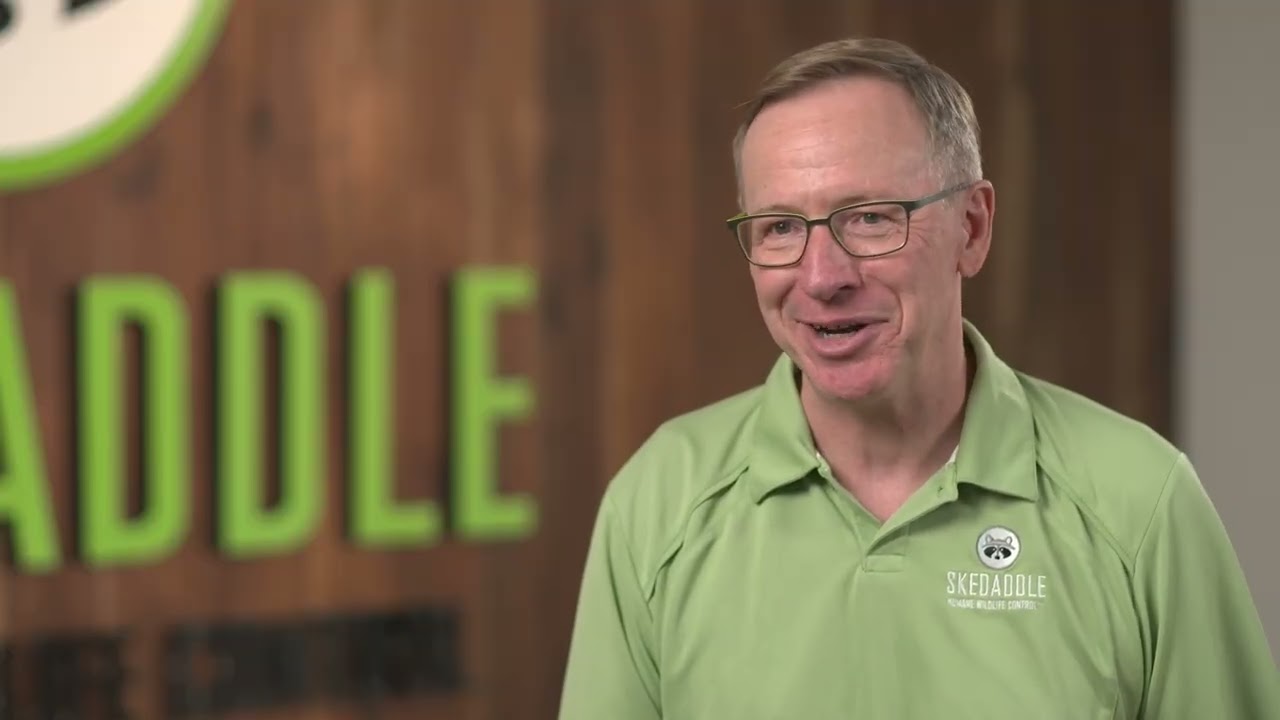
Founder Bill Dowd on why “trap and relocate” fails the homeowner and the animal — and the biology-based method Skedaddle built instead.
Four species account for nearly all of the Nepean work Skedaddle Ottawa is called out for: mice first, then raccoons, squirrels, and bats. The suburb's range of housing — 1950s Bells Corners bungalows, Craig Henry and Manordale infill, Centrepointe townhouses, and the wooded lots of Country Place — gives each animal its own way in, while the Greenbelt and the Rideau River corridor keep restocking the neighbourhoods that border them. Here is what homeowners notice first, and how each species is removed without traps or poison.
How do mice get inside Nepean homes? In the post-war streets of Bells Corners, Fisher Heights, and City View the weak points are sill plates, basement window wells, and aging service penetrations. Numbers rise once October nights turn cold and the field edges along the Greenbelt empty out. Each opening is sealed with rodent-proof material, and indoor activity is monitored until it ends.
Why do raccoons target Nepean attics? Roofs around Parkwood Hills, Craig Henry, and Manordale carry soffit returns and vents that a determined female can widen overnight, and den-seeking peaks from March through June. A technician locates the family, retrieves the kits by hand, lets the mother leave under her own power through a one-way door where appropriate, then reinforces the route she used.
Where do squirrels enter Nepean roofs? Gable louvers and roof-vent screens, particularly on the mature canopy streets near Meadowlands, Centrepointe, and Woodvale where limbs reach the roof edge. Litters arrive in late winter and again in midsummer. A one-way door is fitted where appropriate, the nest is confirmed empty, the roof line is closed with heavy-gauge mesh, and the repair is guaranteed.
When is bat exclusion possible in Nepean? Ontario MNR guidance advises against it from mid-May to mid-August, while pups cannot yet fly. That leaves species-appropriate exclusion from late August into November and again in April, with full sealing between December and March once the roost is empty.
Fall brings a second tier of Nepean calls. Skunks dig in under decks, porches, and shed floors ahead of winter, most often where Crystal Beach and City View yards back onto Greenbelt land. Rats turn up near the Merivale commercial corridor, and the fix there is closing the opening rather than baiting. Birds leave dryer, bathroom, and roof vents packed with nesting material, which stops the duct venting until the material is cleared. Call (613) 231-2222 or learn more about wildlife removal in Ottawa.
Our Nepean technicians can identify the species and confirm the entry points during a single on-site visit.
What areas of Nepean does Skedaddle service? Skedaddle Ottawa serves more than 25 Nepean neighbourhoods. Nepean is the largest of Ottawa's six western and southern suburbs by population, tracing back to a township established in 1792, and amalgamated into the City of Ottawa in 2001. Its geography spans from the Rideau River on the east to the National Capital Commission Greenbelt cutting through its centre, giving Nepean a mix of dense inner-suburb neighbourhoods and greener outer communities. That breadth of housing stock and geography shapes the wildlife pressure Skedaddle Ottawa sees across Nepean year-round. If your home is inside Nepean, Skedaddle services it.
What happens during a Skedaddle wildlife inspection? It is a full property walkthrough — interior, exterior, roof line, and attic — to find every current and likely entry point. The technician confirms the species, documents the damage, and hands over a written quote itemizing exclusion, decontamination, restoration, and guarantee scope before any work begins.
There is no pressure to book on the spot. Where an attic in Bells Corners or Craig Henry needs decontamination or new insulation, that restoration scope is priced on the same written quote as the exclusion, so nothing surfaces later as a surprise. The quote stays with the homeowner, and the office answers questions afterward. Call (613) 231-2222 or see the full inspection process.

We begin with a detailed inspection of your home to identify the wildlife, locate active entry points, and assess the extent of the problem. Our technicians then use proven, species-appropriate methods to remove animals safely and humanely.
Learn more
After the animals are removed, we clean and decontaminate affected areas, removing nesting materials, droppings, and other traces left behind. When needed, we also address damaged insulation and help restore the space to a clean, healthy condition.
Learn more
Finally, we identify vulnerable areas and seal confirmed or potential entry points to help prevent wildlife from returning. Our durable exclusion work provides lasting protection and includes a lifetime warranty on the entry points we seal.
Learn moreWhen is Nepean wildlife most active? Peak activity in Nepean runs March through November, with two clear pressure points: spring nesting (March–June), when raccoons and squirrels seek attic space to raise young, and fall entry (September–November), when mice look for warm indoor shelter as overnight temperatures drop. Winter denning continues quietly through the coldest months.
| Season | Active species | Notes |
|---|---|---|
| Winter (Dec–Feb) |
Mice (indoor activity), raccoons (attic denning), squirrels (attic denning) | Scratching in walls, insulation damage visible, animals heard moving inside during the coldest weeks |
| Spring (Mar–May) |
Raccoons (nesting), squirrels (nesting), bats (returning) | Attic scratching, chimney activity, daytime raccoon sightings around Bells Corners and Bayshore |
| Summer (Jun–Aug) |
Bats — exclusion paused mid-May to mid-August under Ontario MNR guidance — juvenile squirrels | Bats in living spaces, baby-animal calls, chirping or fluttering heard in the roof at dusk |
| Fall (Sep–Nov) |
Mice (peak entry), squirrels (food storing), raccoons (pre-winter denning) | New scratching sounds at night, droppings in the basement or garage, new entry points appearing in Centrepointe and Craig Henry |
Right now in Nepean: Mice are the season's main event. As overnight lows fall they move indoors across Meadowlands, Centrepointe, Craig Henry and the Bells Corners and Bayshore streets, and that pressure holds from September through November. Squirrels are storing food and testing soffits and roof-vent screens, and with the pups now flying the mid-May to mid-August pup season has closed, so bat colony exclusion is open again into November. Getting the openings sealed now is what keeps the winter quiet. Call (613) 231-2222 or learn more about mouse removal.
Because the nights are getting cold. Fall is when mice look for shelter from the coming cold, and Nepean gives them plenty of starting points — the Greenbelt edge at Bells Corners and Bayshore, the Rideau River corridor, and the grassy margins around the Merivale commercial strip. From there it is a short move into the nearest warm, dry building with an opening already waiting.
Smaller than most people expect. Mice can squeeze through cracks as small as a dime, and a worn threshold under a door is enough on its own. Nepean's housing stock spans several decades, so the weak points differ street to street: settled foundations and original soffit returns in Woodvale and City View, and vent penetrations, garage door seals and utility entries on the newer Centrepointe and Craig Henry builds. An inspection walks the whole exterior rather than only the room where the noise is.
Droppings along a basement wall, at the back of a kitchen cupboard, or on a garage shelf are usually first. After that: scratching or scurrying inside a wall or ceiling after dark, shredded paper or insulation pulled into a nest in a quiet corner, gnaw marks on food packaging, and a musty smell in a closed space. A mouse seen in daylight generally means others are already established.
Sealing is what actually ends it. Ottawa Public Health's rodent guidance puts shutting the animals out — sealing every hole and crack in foundations, walls, floors, under doors and around windows — ahead of any baiting step, and Health Canada is explicit that baits and poisons should not be used as the only method of control. Poison also leaves dead mice inside wall cavities and puts pets and other wildlife at risk. Skedaddle's work is exclusion: find every opening, seal it with materials mice cannot chew through, and clean up what the infestation left behind. Call (613) 231-2222 to book a Nepean mouse inspection.
How does Skedaddle remove wildlife humanely in Nepean? The inspection sets the plan — species, season, and the way the house is built all change what the technician does next. No animal is trapped or killed. It leaves under its own movement, the route in is sealed permanently, and the attic is cleaned and restored before the job closes.
Nepean covers everything from post-war Bells Corners bungalows to Centrepointe and Crystal Beach builds, and the method is matched to the species rather than applied by habit. Where appropriate, a one-way door lets an adult raccoon or squirrel leave on its own before the opening is secured. Bat exclusion uses species-appropriate equipment timed outside the mid-May to mid-August pup season, and mouse work is about finding and sealing entry points, not baiting a wall cavity.
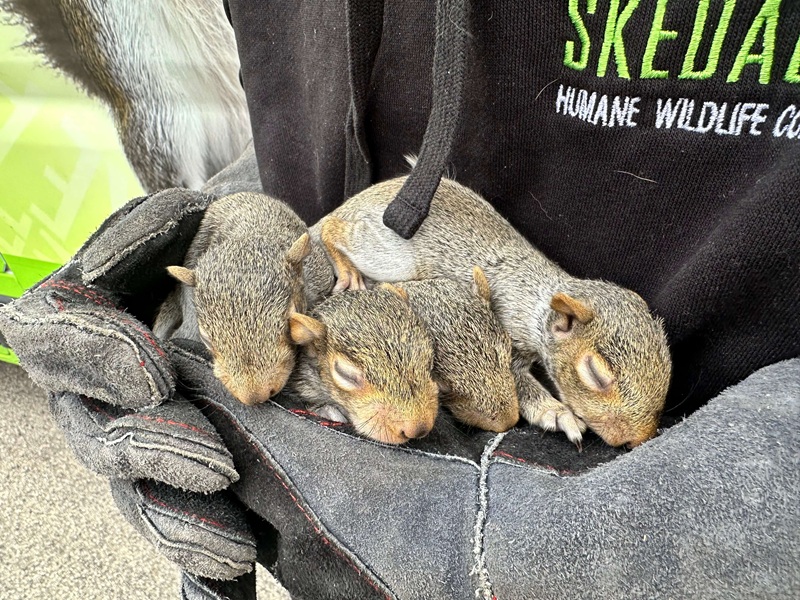
Every spring Skedaddle finds litters in Nepean attics and chimneys from Parkwood Hills to Merivale Gardens, and dependent young are not sealed in. Technicians remove them by hand and place them in an insulated reunion box at the entry point, and the mother relocates them to another den on her own. That is the outcome most homeowners actually want, and it is what humane exclusion means in practice.
What the animal leaves behind still has to come out. Skedaddle clears droppings, soiled batting, and nesting material, treats the affected area to reduce the odour and the scent trail that draws the next animal, and replaces insulation that has been matted or contaminated so the attic performs again. The restoration scope is priced on the written quote, not added afterward.
Weak repairs are why animals come back. Squirrels reopen chewed edges and raccoons lever at soffit returns, so Nepean entry points are closed with heavy-gauge mesh and weather-rated materials, and every serviced area carries Skedaddle's lifetime guarantee on all workmanship and materials. If the same species returns through work we sealed, Skedaddle Ottawa comes back and re-seals it at no charge.
Get a Nepean-specific inspection and a written scope that spells out exclusion points, decontamination, and our lifetime guarantee before any work begins.
Wildlife removal cost in Nepean depends on the species involved, the number of entry points, and whether cleanup or insulation replacement is required. Every Skedaddle Ottawa quote is written and itemized on-site before any work begins, covering exclusion, cleanup, and warranty scope, so you know the full cost before you commit.
Same-day service is sometimes available, but it cannot be guaranteed. Urgent Nepean situations are triaged first — wildlife inside a living space, or an animal trapped or in distress, such as a raccoon loose on a main floor or a bat found in a Centrepointe bedroom. Everything else is booked into the earliest available inspection slot. Call (613) 231-2222 during business hours to check availability.
Ontario's Ministry of Natural Resources advises against bat exclusion from mid-May to mid-August, while flightless pups are still in the roost. Where appropriate, one-way doors are used from late August through November and again from April to early May, with full sealing from December to March once every bat has left. In Nepean the roost is inspected and counted first, and the exclusion is booked in the open autumn window that runs to November.
Skedaddle Ottawa services every residential part of Nepean, from Bells Corners and Bayshore in the west, through Meadowlands, Centrepointe, Craig Henry, and Parkwood Hills, to City View, Fisher Heights, Manordale, Merivale Gardens, Crystal Beach, Country Place, and Woodvale. If a Nepean home sits inside city limits, Skedaddle services it, including the streets along the Greenbelt and the Barrhaven-adjacent southern edge.
Yes. Skedaddle works to the humane standards approved by SPCAs and Humane Societies, and nothing is trapped or poisoned on a Nepean job. Bat colony exclusion is planned around Ontario MNR guidance, which advises leaving a roost undisturbed from mid-May to mid-August while the pups cannot fly. Technicians are trained in wildlife biology, home repair, decontamination, and attic restoration.
Right now in Nepean, mice account for most of the work. As overnight temperatures drop through September, October and November they move indoors across Meadowlands, Centrepointe, Craig Henry and the Greenbelt-facing streets, and the first sign is usually scratching inside a wall or droppings in a basement. Squirrels are caching food and working at soffits and roof-vent screens, raccoons are hunting for winter denning space, and bat colony exclusion is open again now that the pups can fly.
Yes. Every full exclusion job in Nepean carries Skedaddle's lifetime guarantee on all workmanship and materials. If wildlife gets back in through an opening Skedaddle sealed, the crew returns and re-seals it at no charge. The guarantee is written into the same itemized quote that sets out the exclusion and cleanup scope, and it reads the same for a Bells Corners bungalow as for a Centrepointe townhouse.
Once the animal is out and every opening is sealed, the attic is cleared of droppings, urine-soaked insulation, and nesting material, treated to cut the odour and scent trail that draws the next animal in, and re-insulated where the material was contaminated. In Nepean that decontamination and restoration scope is itemized on the same written quote as the exclusion.
A raccoon working at a soffit return on a Parkwood Hills roof will come back to the same seam, a squirrel colony in the Meadowlands canopy will reopen a chewed gable louver, and mice at a Bells Corners sill plate will keep arriving as the Greenbelt edges cool. Skedaddle Ottawa has handled that work in Nepean since 1993: identify the species, match the method to it, seal the opening permanently, decontaminate what was left behind, restore the insulation, and guarantee the seal. Technicians work to humane methods approved by SPCAs and Humane Societies. Call (613) 231-2222 or request an inspection online.
 menu
menu