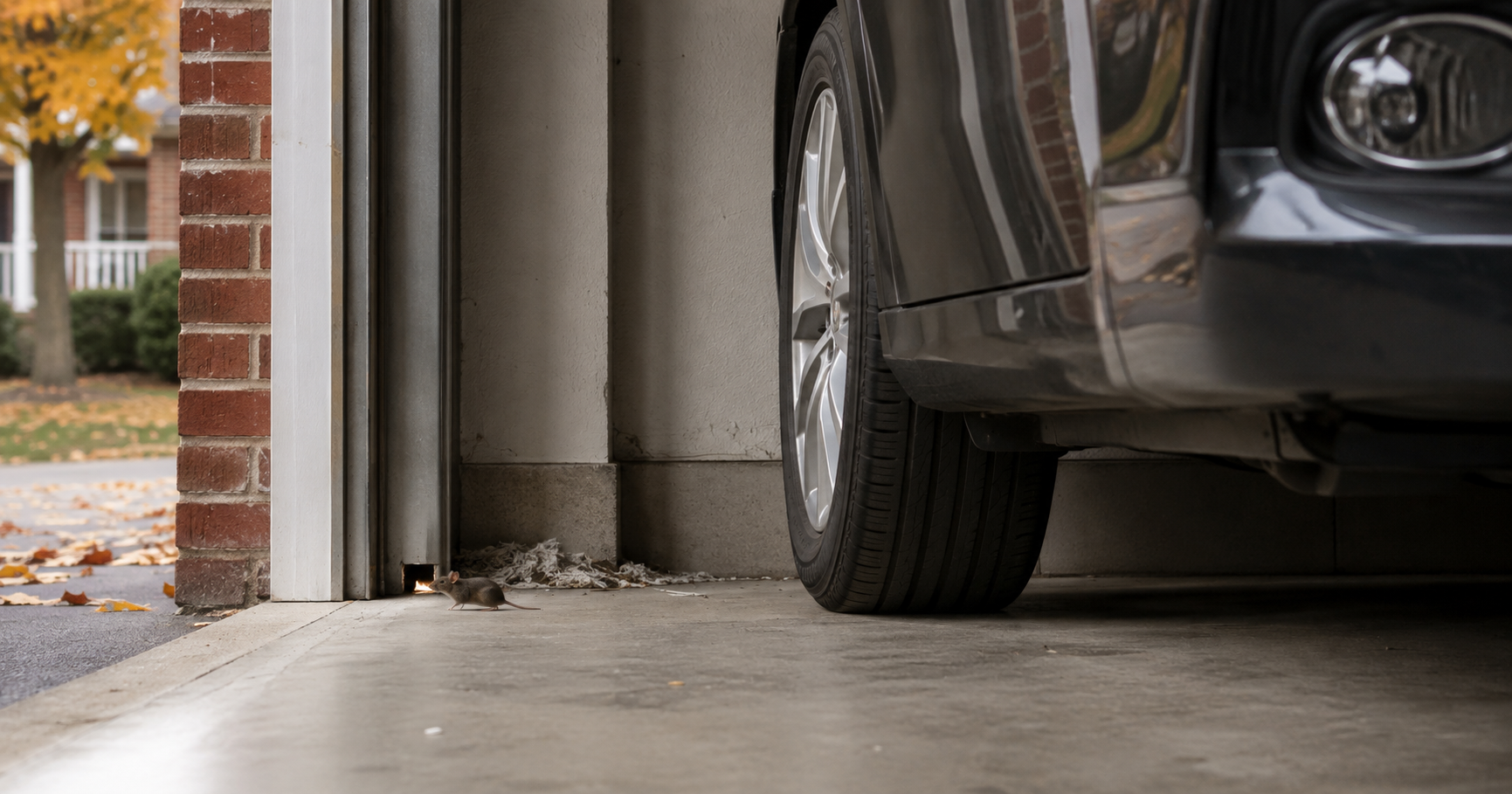
Yes, a parked car can become attractive to mice or rats—but usually not because the vehicle is somehow calling them in. It is more accurate to say that a car can offer what rodents are already looking for: a sheltered place to explore, room for nesting material, protection from weather and, sometimes, food residue. Risk also depends heavily on what is happening around the parking space.
For Toronto drivers, this is not just a theoretical concern. In August 2025, CityNews reported on a local vehicle owner whose knock-sensor wiring had been chewed by rats. The story also raised a popular question about soy-based wire coatings, but the available evidence does not support treating soy as the universal explanation.
This guide will help you spot signs of rodent activity, understand why the fall season can change the pressure around garages and parked vehicles, and decide what to do next. The goal is not to turn you into your own mechanic or wildlife technician. It is to help you make a calm, safe call about who needs to inspect the car—and whether the surrounding property needs professional mice removal as well.
Key answer: A car may give mice or rats shelter, warmth after driving and hidden nesting space, while crumbs, stored seed, garbage and nearby vegetation can bring rodents into the parking area. If you find droppings, nesting material or chewed components, stop disturbing the area, have the vehicle inspected and address rodent activity around the garage or property.
What Actually Makes a Car Useful to Mice and Rats?
When we assess a mouse problem, we look beyond the first place an animal was noticed. Rodents move through an environment by following access, cover and resources. A vehicle parked in that environment may become one more sheltered stop along an established route.
A recently driven engine compartment may retain heat for a while, but warmth is only part of the picture. Underbody spaces, dashboards, air-intake areas and engine bays contain protected voids that can reduce exposure to wind, rain and predators. A vehicle that sits unused gives an animal more time to investigate without vibration, movement or human interruption.
Food changes the equation. A forgotten granola bar, fast-food wrapper, pet treat or child’s snack crumbs can provide a direct reward inside the passenger compartment. Outside the car, unsecured garbage, spilled birdseed, pet food and fallen fruit can draw rodents into the immediate area. The City of Toronto’s rat-control guidance tells residents and businesses to control those same resources and reduce clutter and vegetation that offer shelter.
Nesting material can also make a vehicle more useful. Paper, tissues, upholstery fibres, insulation and debris carried in from outside may be gathered into a protected cavity. None of this means every car parked near a green bin will develop a problem. It means prevention works best when you look at the vehicle, parking space and nearby building as one connected system.
Does Soy-Based Wiring Attract Rodents?
This is the claim we hear most often, and it deserves a careful answer: some automotive materials can contain plant-derived components, but evidence does not show that soybean derivatives make wire coatings inherently more attractive to rodents.
The local question became especially visible when CityNews reported on a Toronto driver’s chewed knock-sensor wire on August 2, 2025. The owner suspected a soy-based coating. Hyundai told CityNews that the wiring material in that vehicle was not soy-based, while a wildlife-control professional interviewed for the report said rodent chewing occurs across many kinds of vehicles and wires.
That distinction is supported by an experimental study published in the ACS Sustainable Chemistry & Engineering journal. In “Assessing Rodent Gnawing of Elastomers Containing Soybean Oil Derivatives”, researchers compared materials and found that including soybean oil or its derivatives did not affect rodent gnawing. In plain language, “soy wiring” is not a reliable diagnosis of why a specific car was damaged.
Rodents gnaw many materials. Their front teeth grow continuously, and chewing helps maintain them while animals also investigate and work around obstacles. Wiring insulation, hoses, foam and plastic can all be vulnerable once a rodent is already inside a protected vehicle space.
Manufacturers recognize rodent damage as a real service issue. A 2022 American Honda service bulletin filed with the U.S. National Highway Traffic Safety Administration instructed technicians repairing specific rodent-damaged harnesses to apply capsaicin-containing deterrent tape. That is evidence of an available repair measure for a defined application—not proof that every vehicle uses soy wiring or that one tape can prevent every recurrence. Your dealership or licensed mechanic should decide what is safe and compatible with your vehicle.
How Can You Tell if Rodents Have Been in Your Vehicle?
The first clue is often small. You may notice debris where it does not belong, a new odour when the fan runs or a warning light with no obvious cause. Treat those clues as a reason to inspect safely, not as proof of a large infestation.
Signs worth taking seriously include:
- Droppings in cup holders, the glove compartment, trunk, engine bay or around the parking space
- Shredded paper, fabric, insulation, dried grass or other nesting material
- Gnaw marks on visible plastic, insulation, hoses or wiring covers
- Food packaging that has been disturbed
- A musty or urine-like odour, especially through the heating or air-conditioning system
- Dashboard warnings, electrical faults, a no-start condition or unusual vehicle behaviour
- Rodent tracks, burrows or repeated sightings around the garage, garbage area or building foundation
Do not reach into an engine compartment, dashboard void or nest. The engine may contain hot, sharp, moving or electrically energized parts, and damaged wiring or hoses can create a vehicle-safety concern. If warning lights appear, the car runs abnormally or you can see chewed components, contact a qualified automotive professional before driving it.
It also helps to distinguish the symptom from the source. A nest in the engine bay is a vehicle problem. Droppings along the garage wall, gaps under a garage door and noises in an adjoining wall suggest a wider property problem. That second set of clues is where a Toronto mouse removal assessment becomes relevant.
Why the Fall Season Changes the Risk Around Toronto Parking Areas
House mice can be active throughout the year, so this is not only a winter problem. Still, fall deserves extra attention. Health Canada notes that deer mice may invade buildings near fields and woodlands in fall, and the Canadian Conservation Institute describes late-autumn entry into buildings for winter shelter as common rodent behaviour.
Toronto’s urban form creates many transitions between cover and buildings: ravines, mature residential landscaping, laneways, garages, sheds, loading areas and dense commercial waste zones. A car parked beside one of those travel routes can become part of the available shelter, particularly if it remains still for long periods.
The practical seasonal point is not that a certain temperature automatically sends mice into cars. Weather, food availability, disturbance, habitat and the individual property all interact. What changes in fall is the value of sheltered space—and the number of opportunities rodents may test as outdoor conditions become less forgiving.
A sourced seasonal decision guide
| Period | What may change | Sensible response |
|---|---|---|
| Late summer | Seed, fruit, outdoor dining waste and garage clutter may keep food or cover close to parking areas. | Clean the vehicle and parking area; secure food, birdseed and waste. |
| Early fall | Cooler nights increase the value of protected spaces; some mice begin entering buildings. | Check garage-door edges, utility gaps and signs along walls before activity moves deeper inside. |
| Late fall | Federal guidance identifies late-autumn entry into buildings for winter shelter as common rodent behaviour. | Increase visual checks of vehicles that sit unused and arrange property exclusion if signs appear. |
| Winter | Indoor rodents remain active, and a sheltered vehicle may still be used even when it is parked inside. | Do not assume cold weather solved the problem; address vehicle damage and building access together. |
This guide synthesizes Health Canada’s species guidance, federal building-pest guidance, the City of Toronto’s attractant-control advice and Skedaddle’s verified Toronto service information. It is a planning tool, not a prediction of rodent activity on a particular day.
What Should You Do if You Find Droppings or a Nest?
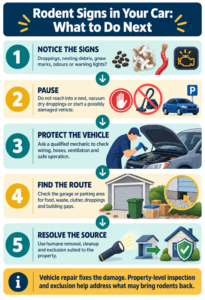
First, pause. Starting the car, switching on the fan, vacuuming debris or pulling out a nest can disturb contaminated material or create a mechanical problem. If an animal may still be present, give it space and keep children and pets away.
The Public Health Agency of Canada’s current hantavirus guidance says infection is rare and the risk in Canada is low. It also explains that virus particles can become airborne when contaminated rodent urine, droppings or nesting material are swept or vacuumed. That is why dry cleanup is the wrong first response.
For a small, accessible contamination area, follow current public-health directions rather than improvising. Heavy contamination, confined spaces and material inside ventilation or mechanical components deserve professional advice. A vehicle-detailing service is not automatically trained to assess biohazard contamination, and a wildlife company is not a substitute for an automotive technician. Ask each provider what work it is qualified to perform.
Use this order of operations:
- Protect people and pets. Avoid direct contact and do not disturb a suspected nest.
- Protect the vehicle. Contact a licensed mechanic or dealership if components may be damaged, warning lights are present or the animal could be in a mechanical area.
- Assess contamination. Follow public-health cleanup guidance and use trained help when contamination is extensive or difficult to access.
- Find the source. Check the garage, parking area and building for droppings, rub marks, gnawing and openings without sealing an animal inside.
- Plan humane removal and exclusion. Address active rodents before vulnerable openings are permanently secured.
If anyone has been bitten or scratched, or had direct contact with a rodent and is concerned about exposure, contact a healthcare provider or public-health authority. This article cannot assess an individual medical situation.
Which Prevention Steps Help—and Which Ones Can Mislead You?
The best prevention is usually unglamorous: remove food, reduce cover, interrupt undisturbed shelter and correct access around the property. A strongly scented product may feel like action, but it does not tell you whether a mouse is inside the car, whether wiring is damaged or how rodents reached the garage.
Helpful habits around the car
- Remove food, wrappers and drink residue from the passenger compartment and trunk.
- Clean child-seat crevices, floor mats and cargo areas where crumbs collect.
- Avoid storing grass seed, birdseed, pet food or snacks in the vehicle or in thin, chewable containers nearby.
- Check a vehicle that sits for long periods, especially before seasonal use.
- Keep the parking area free of cardboard, fabric, leaf piles and other easy cover or nesting material.
- Ask a mechanic about manufacturer-approved inspection and protection options after documented rodent damage.
Helpful habits around the property
- Use tight-fitting lids on garbage and organic-waste containers.
- Clean spilled seed and fallen fruit and do not leave pet food outside.
- Reduce dense weeds and clutter beside garages, sheds and parking pads.
- Repair building gaps with durable, appropriate materials after confirming animals will not be sealed inside.
- Look beyond the obvious opening. Mice can use small gaps at door edges, utility penetrations and foundations.
Be cautious with ultrasonic devices and scent remedies. Health Canada says rodents may adapt to ultrasonic devices and return. Peppermint, dryer sheets and similar suggestions also should not replace inspection, sanitation, automotive repair or exclusion. Never place loose materials or unapproved products in an engine bay; they may interfere with heat, airflow, belts, fans or electrical systems.
Why Mice Removal May Need to Start Outside the Car
A mechanic can repair a chewed harness, clear a blocked air intake and determine whether a vehicle is safe to operate. What that repair may not answer is why rodents are repeatedly reaching the car.
That question leads back to the property. In a garage, mice may travel along walls, pass under a worn door seal, enter around utilities or nest in stored belongings. In a commercial lot, the pressure may come from waste handling, food premises, loading areas, landscaping or a neighbouring structure. Toronto’s own guidance frames rodent prevention around food, water and shelter because those conditions sustain activity at the site level.
Humane exclusion means allowing or helping animals to leave in a way suited to the species and situation, then securing the access that made the problem possible. It is not simply plugging the first visible hole. Sealing too soon can confine animals inside a wall, garage or connected building space.
Skedaddle’s Toronto mouse process begins with a 50-point inspection to identify entry points and offers exclusion services such as one-way doors for mouse removal, cleaning and sanitizing services where appropriate, and professional-grade exclusion materials used to help prevent re-entry. The plan and written quote are customized to the property.
This is also why poison is a poor fit with a prevention-first article. It does not repair a garage-door gap, remove food residue or explain a vehicle warning light. It can also leave an animal inaccessible inside a structure. Our focus is prevention rather than poison: understand the route, remove the animals humanely and protect the building against repeat entry.
Where applicable to the completed work, Skedaddle states that its workmanship and materials are covered by a lifetime guarantee. The written scope for a specific property should always explain what is included; a building exclusion guarantee should not be read as a warranty on vehicle components.
A Two-Track Plan for Vehicle and Property Protection
Vehicle rodent activity sits between two specialties. Trying to force one provider to solve both sides can leave an important gap.
Track one: the vehicle. A qualified automotive professional diagnoses warning lights, damaged wiring, hoses, insulation, ventilation and safe operation. They can advise whether manufacturer-approved protective materials are available for that make and model.
Track two: the site. Skedaddle Humane Wildlife Control identifies rodent signs, active entry points and attractants in the garage or building, then creates a removal, cleanup and exclusion plan suited to the property.
For a homeowner, the two tracks may involve one car and one attached garage. For a business, the review may need to include fleet vehicles, storage rooms, loading docks, staff food areas, waste containers and neighbouring units. Keep a simple record of dates, vehicle locations, photographs and repairs. Patterns—such as repeated damage after parking beside one wall—can help both professionals focus their inspections without pretending that correlation alone proves the entry route.
Frequently Asked Questions About Rodents in Cars
Will mice leave a car when I start driving it regularly?
Movement and disturbance may make a vehicle less comfortable, but driving is not a dependable removal method. A mouse can remain hidden, a nest may stay behind and chewed wiring or contaminated ventilation can still require attention. If you suspect an animal is in a mechanical area, do not start the vehicle simply to force it out. Ask an automotive professional to assess safe operation, then investigate rodent activity around the parking site.
Can I safely vacuum mouse droppings from my car?
Do not vacuum or sweep dry rodent droppings. The Public Health Agency of Canada warns that disturbing contaminated urine, droppings or nesting material can release particles into the air. Follow current federal wet-cleaning and disinfection guidance for a small accessible area, and seek qualified help from Skedaddle for heavy contamination or material inside ventilation, dashboards or other confined spaces. A mechanic should address any concern involving vehicle systems before cleanup disturbs components.
Does a clean car guarantee that mice will stay out?
No. Removing crumbs and food packaging eliminates an obvious attractant, but a clean vehicle may still provide shelter. Risk also depends on nearby garbage, seed, pet food, vegetation, clutter, building openings and how long the vehicle remains undisturbed. Think in layers: keep the interior clean, make the parking area less supportive of rodents, inspect the garage or building and respond quickly to new signs.
Are rats or mice more likely to damage a Toronto vehicle?
Either can enter or investigate vehicle spaces, and chew marks alone may not identify the species. Mice are smaller and may exploit very tight gaps; Toronto identifies both mice and rats as urban rodents, while its rat guidance describes rats as ground-oriented burrowers that often travel along protected edges. Dropping size, tracks, burrows, nesting material and the wider site pattern help a trained professional make a more reliable identification.
Who should I call first: a mechanic or a wildlife-control company?
Call a mechanic first when warning lights, starting problems, visible component damage, leaking fluid or unsafe operation is possible. Call wildlife control when you also find droppings, nesting or repeated activity in the garage, building or parking area. In many cases you need both: the mechanic protects the vehicle, while a humane wildlife-control assessment addresses animals, attractants and access around the property that could lead to another repair.
Protect the Car by Addressing the Whole Property
A chewed wire may be where the problem becomes expensive, but it is rarely the whole story. The more useful question is not simply, “What attracted a mouse to my car?” It is, “What allowed rodents to live or travel close enough to keep investigating it?”
Start with safety: avoid disturbing droppings or nesting material and have suspected vehicle damage assessed. Then remove food, waste and clutter around the parking area and look for signs that connect the car to a garage, shed, loading area or building opening.
If mice are active around your Toronto home or business, our local team can inspect the property, explain what we find and develop a customized humane removal and exclusion plan. Learn more about humane wildlife control in Toronto or request service through our Toronto mouse removal page. Addressing the route—not only the damaged component—gives you the best chance of keeping the next repair off your to-do list.

 Loading...