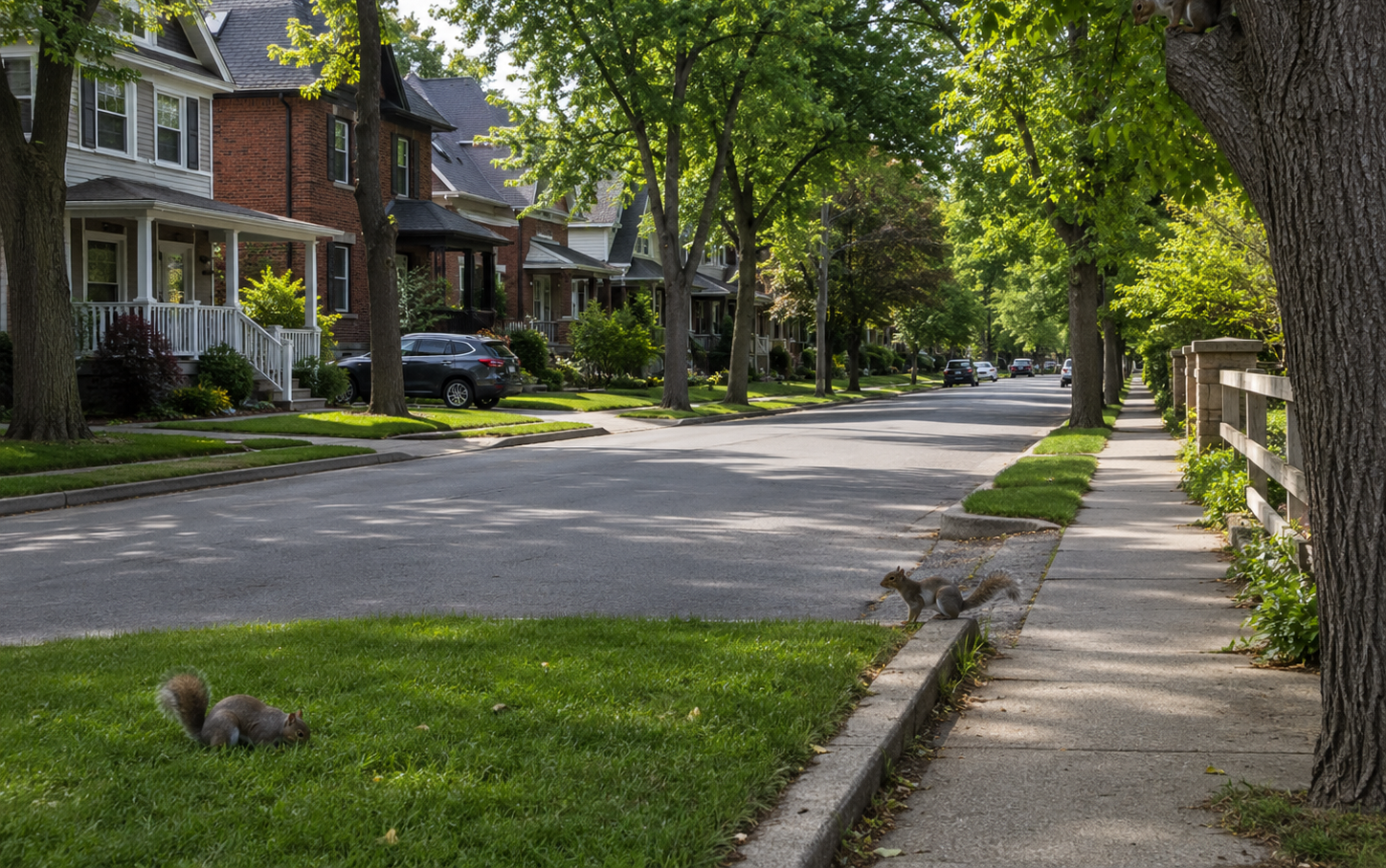
You hear fast scratching above your ceiling. It stops, then starts again. If you live in one of Toronto’s older neighbourhoods, there’s a very good chance you have a squirrel in your attic — and there’s an even better chance it got there through a branch hanging over your roof. Toronto’s mature tree canopy and aging rooflines work together to give these animals easy access to homes all summer long. In this blog, Skedaddle Humane Wildlife Control in Toronto walks you through why this happens so often in this city and what our team does to stop it.
Toronto’s tree canopies and older rooflines create the perfect summer entry point for squirrels because the city is basically one big connected highway for them. Branches hang over rooftops, utility wires run along fence lines, and detached garages sit close enough to jump from. Once they reach a roofline, aging soffits, loose fascia boards, and old vent covers give them all the weak spots they need to chew their way in. You don’t have to have a damaged roof for this to happen; you just need a tree, a wire, or a fence close enough to use as a bridge.
You should never try to deal with a squirrel problem on your own. They move fast, they can bite if they feel threatened, and handling their nesting material without the right protective gear is a real health risk. Our team at Skedaddle handles the whole job safely and humanely from start to finish.
Where Do Squirrels Nest?
Squirrels nest in two main places: trees and attics. In nature, they build nests in the forks of tree branches or inside hollow trunks. In a city like Toronto, attics make an even better option because they are warm, dry, protected from predators, and filled with soft insulation that is perfect for building a nest.
During the summer, females are raising their young and looking for the safest, most sheltered spot they can find. An attic in a quiet residential home fits that description exactly. Once a female finds a way in, she builds her nest and stays until her young are old enough to leave, which can take several weeks.
The nesting damage that builds up during that time is significant. Insulation gets ripped apart, droppings accumulate, and urine soaks into the wood around the nest site. By the time most homeowners notice the problem, the nest is already well established and cleanup is a major job. That is why calling our team at the very first sign of attic activity is always the right move.
The Aerial Highway
Toronto is one of the most tree-covered cities in North America, and that canopy is one of the biggest reasons squirrel activity on rooftops is so common here. In neighbourhoods like the Annex, High Park, the Beaches, and Leslieville, mature trees grow close to homes and in many cases, their branches reach directly over or onto the roofline.
For these animals, a branch that hangs over a roof is a direct bridge. They don’t need to climb a wall or find another route — they simply run along the branch and land on the roof. From there, they start checking every inch of the roofline for a weak spot to get through. The more mature the tree and the closer it grows to the home, the easier this route becomes.
Here is what the aerial highway looks like in practice:
- Overhanging Branches as Launch Pads: A branch that extends over your roofline by even a small amount is enough for a squirrel to use as a jumping point. They can clear the gap easily and land directly on the roof surface. In Toronto’s older neighbourhoods, it is very common to see trees growing close enough to homes that branches touch the fascia, soffit, or shingles directly. No jumping required at all.
- Connected Canopies Across Whole Blocks: In some Toronto neighbourhoods, the tree canopy is so dense that these animals can travel across multiple properties without ever coming down to street level. They move through the tree tops from yard to yard, which gives them a huge range to explore without the risk that comes with being on the ground. Homes anywhere along a connected canopy corridor are potential targets, not just the ones directly beside large trees.
- Summer Leaf Cover Hides the Activity: In summer, full leaf cover makes it much harder to see the animals moving through the canopy and along rooflines. Activity that would be obvious in winter when trees are bare can go completely unnoticed for weeks in summer. By the time you hear scratching in the attic, they have often been using the aerial route to your roof for a while already.
Wires, Fences, and Garages
Not every home in Toronto has a large tree growing right beside it, but almost every home has a fence, a utility wire, or a detached garage nearby. These structures act as secondary highways that connect the ground level to the roofline in neighbourhoods where trees don’t quite reach.
Squirrels run along the top of wooden backyard fences with ease, using them to travel from yard to yard and from one structure to another. Utility wires that run close to a home give them an elevated path that leads directly to the roofline. Detached garages, which are very common in older Toronto neighbourhoods, provide a lower stepping-stone that makes reaching the roof of the main house much easier.
Here is how these secondary routes work:
- Utility Wires as Elevated Pathways: Hydro lines and other utility wires that run close to a home give these animals an elevated route that bypasses the ground entirely. They are comfortable running along wires and will use them to bridge the gap between a tree or fence and the roofline of your home. Once on the wire, the jump to a soffit or fascia board is short and easy.
- Backyard Fences as Travel Corridors: A wooden fence running along the back of your yard is a natural travel route. They use fence tops to move from yard to yard without touching the ground, and a fence that runs close to your home or garage gives them a direct path to a higher surface. In the tight lot sizes of older Toronto neighbourhoods, this kind of connection between fence and structure is extremely common.
- Detached Garages as Stepping Stones: Many Toronto homes, especially in East York, Leslieville, and similar areas, have detached garages at the back of the property. A garage roof sits lower than the main house, which makes it an easy first step. From the garage roof, getting to the main home’s roofline is a short jump that brings them right to the soffits and vents they look for.
Tight Rooflines and Aging Soffits
Once they reach a roofline, getting inside is usually just a matter of finding the right weak spot. Toronto’s older homes – Victorian houses, post-war bungalows, and semi-detached properties built decades ago have rooflines with a lot of detail and a lot of aging materials. Dormers, gables, valleys, and the spots where different roof sections meet are all areas where materials wear down and gaps develop over time.
Soffits are one of the most common entry points. The soffit runs along the underside of the roof overhang, and in older homes, the material can become loose, crack, or pull away from the fascia board. A gap that looks small from the ground is often easy for these animals to chew wider. Their teeth are strong enough to get through wood, plastic, and lightweight aluminum without much effort.
Here is what makes tight rooflines and aging soffits such a problem:
- Complex Rooflines Create More Potential Entry Points: The more detail a roofline has – dormers, multiple pitches, valleys – the more spots there are where materials meet and gaps can form. Every junction on a roofline is a potential weak spot, and older homes tend to have more of them than newer builds. Regular professional inspection of these areas is the best way to catch problems before they become entry points.
- Aging Soffit and Fascia Materials: Wood soffits that have been through decades of Toronto winters and humid summers can become soft, cracked, or loose. Even aluminum soffits can pull away from the fascia over time. These small gaps are exactly what they look for and once they find one, they chew it wider until it is big enough to squeeze through. Our team replaces damaged materials with durable options that hold up against future attempts.
- Existing Gaps that Go Unnoticed: Many of the gaps on a roofline are too small to see from the ground and go undetected until something gets in. A gap around a roof vent, a loose piece of flashing, or a small opening at the soffit edge might not look like much, but it is more than enough. Our team inspects from the roofline itself so nothing gets missed.
Shared Walls
Toronto’s densely packed semi-detached and row houses create a challenge that is unique to this kind of housing — shared rooflines. When two homes share a wall and a connected roofline, a gap on one side of the structure can give access to the attic space on both sides. These animals are very good at travelling through connected spaces, and a shared roofline makes it easy to move between adjacent homes once inside.
This also means that a gap on your neighbour’s side of the roofline can become your problem. If the space where your two homes connect has a weak spot, they can get into the shared wall cavity or travel along the connected soffit line to find a way into your attic. In semi-detached and row housing, what happens to one home often affects the one next to it.
Shared wall situations are one of the reasons a thorough inspection matters so much. Our team checks all of the connection points on shared rooflines, not just the obvious areas on your side of the structure. Finding and sealing every vulnerable spot, including those at the shared wall junction, is what keeps the problem from coming back through a neighbouring entry point.
Backyard Renovations
Summer is prime time for backyard renovations in Toronto. New decks, fences, landscaping projects, and shed construction all happen during the warmer months. While this is great for your property, it can also disturb the places where squirrels have been nesting and feeding in your yard. A renovation that disrupts their usual habitat pushes them to look for new shelter fast, and your attic is often the closest available option.
Construction activity also creates temporary gaps and openings in your home’s exterior that can be exploited quickly. A section of soffit removed during a renovation, an open vent that hasn’t been reinstalled, or a gap created by new construction next door can all become entry points before the work is finished. In the middle of a renovation, these openings are easy to overlook, but they won’t be overlooked by an animal actively searching for a way in.
Backyard renovations are one of the less obvious triggers for sudden attic activity. If you have recently had work done in your yard or on the exterior of your home and have started hearing noises in the attic, a connection between the two is very possible. Our team assesses the full situation during the inspection so the entry point gets found and closed, no matter how it developed.
Squirrel Removal and Prevention in Toronto
When our team arrives at your home, the first thing we do is a full check of the whole property. We look at the roofline, the attic, every soffit and vent, the garage, the fence lines, and the trees nearby to get a full picture of how they are getting in and what is making your property easy to access. That complete view is what allows us to build a plan that actually solves the problem.
Our removal process uses one-way door systems at the active entry points. These let the animals leave the attic on their own but stop them from getting back in. Once the home is clear, we seal every opening with tough materials that hold up against chewing and future entry attempts. All cleanup of droppings, nesting material, and contaminated insulation is handled by our team, homeowners should never go near any of this material without the right protective gear.
For Toronto homeowners dealing with regular roofline activity, we also flag the environmental factors during the inspection — branches that need to be trimmed back, fence lines that connect to the roofline, and other things that make the property easy to reach. Sealing the home properly is the most important step, but understanding what is drawing them there helps make sure the problem doesn’t come right back.
Squirrel Challenges in Toronto
Toronto’s combination of mature trees, older homes, and dense residential layout makes it one of the most active cities in Ontario for squirrel-related attic problems. The neighbourhoods with the most activity tend to be the ones with the oldest housing stock and the densest tree cover — the Annex, High Park, East York, Roncesvalles, the Beaches, and similar areas where large trees grow right alongside older homes.
Summer is the busiest season for this kind of activity. Females are raising their young and looking for safe, sheltered nesting spots, which makes them more motivated and more persistent than at other times of year. Activity that starts in late spring often peaks through June, July, and August before tapering off in early fall.
Our team responds to calls across Toronto year-round and knows the specific conditions that drive this kind of activity in different parts of the city. We understand which neighbourhoods have the most roofline vulnerability, how the local tree canopy affects the risk on a given property, and what older home styles are most commonly targeted. That local knowledge helps us work faster and more thoroughly.
Frequently Asked Questions
How do I know if squirrels are in my attic?
The most common signs are fast scratching or scurrying sounds from the attic, especially in the early morning or late afternoon when they are most active. You may also notice damage around the roofline, chewed soffit edges, or small droppings in the attic if you look up there. If you hear these sounds, call our team right away. do not go into the attic yourself.
Can squirrels cause serious damage to a home?
Yes. They chew through electrical wiring, tear apart insulation, and leave droppings and urine that contaminate the attic space. Chewed wiring is a real fire risk, and contaminated insulation needs to be professionally removed and replaced. The longer they stay, the more extensive and expensive the damage becomes.
Do squirrels nest in attics year-round?
They are most active in summer when females are raising young and again in fall when they are preparing for winter. However, once a good entry point into an attic has been found, they can use it at any time of year. That is why sealing every entry point properly after removal is so important.
Why do I keep hearing squirrels on my roof even after I thought the problem was fixed?
If the activity continues after a previous attempt to deal with it, the entry point was likely not fully sealed or a new one has opened up nearby. These animals are persistent and will keep checking for weak spots. Our professional inspection of the full roofline is the best way to find every point of access and close it off properly.
Can my neighbour's squirrel problem affect my home?
Yes. In semi-detached and row housing especially, a gap on a neighbour's roofline can give access to the connected attic space or shared wall cavity. Even in detached homes, activity on a neighbouring property can push these animals toward yours. Our team checks the full roofline, including shared connection points, during every inspection.
Stop Letting the Tree Outside Be Their Front Door
Toronto’s tree canopy is beautiful, but it is also one of the main reasons squirrel-related attic problems are so common in this city. Branches, wires, fences, and garages all give them easy paths to your roofline, and aging soffits and older building materials give them plenty of weak spots to push through once they get there.
The damage that builds up during a single nesting season. Ripped insulation, chewed wiring, and contaminated attic space are significant and get worse the longer the problem goes unaddressed. Acting at the first sign of rooftop or attic activity is always the right call.
At Skedaddle Humane Wildlife Control in Toronto, we’re there for you. Our team inspects your full roofline and attic, excludes the animals using one-way doors, seals every entry point with durable materials, and handles all cleanup so you don’t have to go near any of it. Request an estimate today and let our team close off the entry points before another summer of rooftop activity turns into an attic problem.

 Loading...