Confirm what's nesting
Bees, wasps and hornets can look alike at a glance, and identifying the species is key to choosing the right treatment. We make sure of what's at your home before anything else happens.
GTA Wasp & Hornet Control
Contact Us
Spotted an empty paper nest under the eaves this winter? Now's the time to close the gap behind it.
Skedaddle GTA removes wasp and hornet nests from soffits, wall voids, decks and lawns across Toronto and the GTA, from Burlington to Oshawa and north to Newmarket. We confirm what's nesting, take out the nest and treat the spot so it isn't quickly recolonized, then screen the void so it isn't used again next year. The same local GTA team handles both pest control and wildlife removal.
Bees, wasps and hornets can look alike at a glance, and identifying the species is key to choosing the right treatment. We make sure of what's at your home before anything else happens.
Swatting or spraying the wasps you can see leaves the colony working behind the siding. We remove the nest and treat the site so it isn't quickly recolonized.
Every wall or soffit nest started at an opening. Once the nest is gone, we screen that void so it isn't reused next year.

A steady stream of wasps flying in and out of the same crack in the siding, soffit or roofline almost always means a nest inside. Soffits and wall voids are two of the most common places we find them.
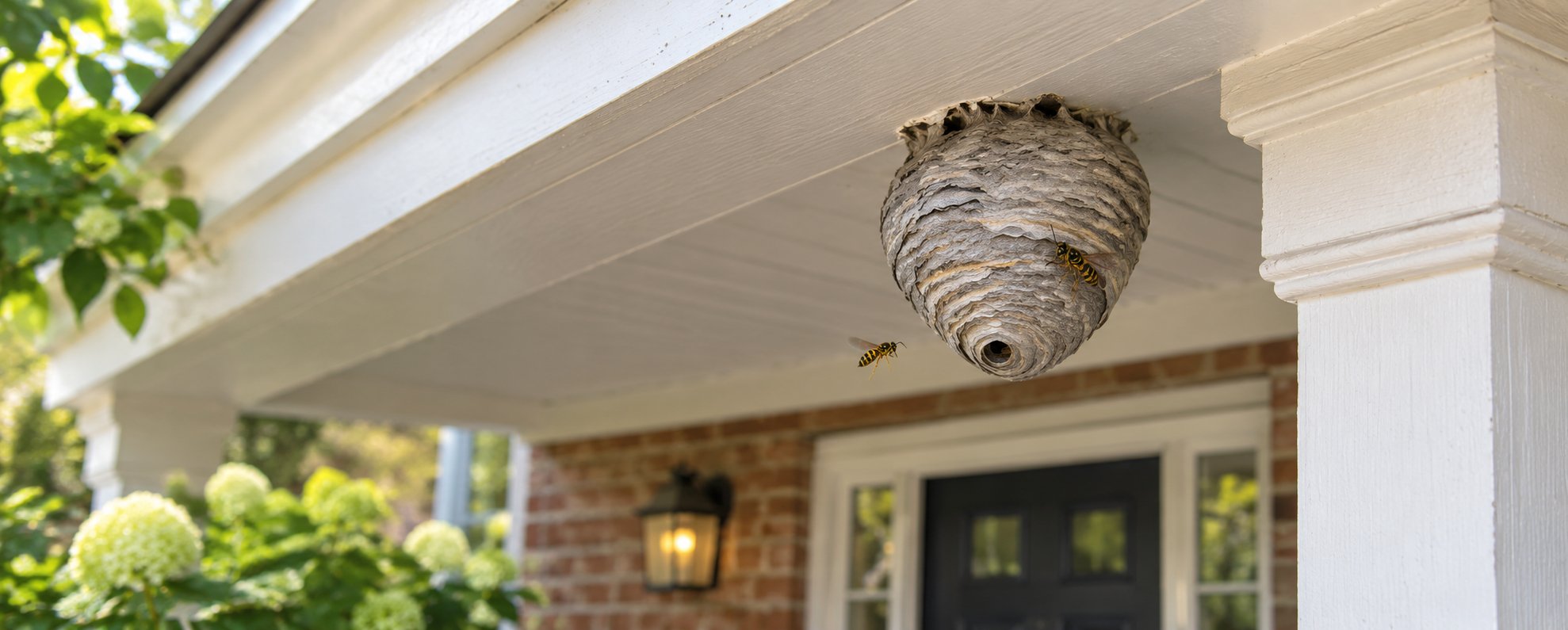
Paper wasps hang small, open, umbrella-shaped combs from eaves, door frames and shrub branches. A larger, fully enclosed grey nest in a tree or under an overhang usually belongs to bald-faced hornets.
Some yellow jackets nest in the ground, often in an old rodent burrow. Wasps going in and out of one hole in the lawn, a garden bed or beside a walkway point to a ground nest.

Tell us where they're coming and going and how close it is to where people walk. We'll confirm what's nesting and find the nest before we recommend any treatment.
Most stinging-insect trouble around GTA homes comes from social wasps. In its wasp control tips for homeowners, Health Canada describes yellow jackets and hornets as 10 to 25 mm long with black and yellow or white bands, calls social wasps the most dangerous because of how they behave, and singles out the German yellow jacket as the most aggressive. Unlike bees, wasps can sting more than once.
Two hornets turn up here as well. The province's northern giant hornet fact page says the bald-faced hornet is common throughout Ontario and is actually part of the yellow jacket family, mostly black with white markings. The European hornet is larger, at 2.5 to 3.5 centimetres, and is common in parts of Ontario. The same page notes that the aerial nesters build in tree branches and overhangs, while other yellow jackets nest in sheltered spaces within buildings or in ground cavities.
Wall nests call for patience. Blocking the entrance of an active colony can send wasps chewing through into the house, so we never close a void while the nest is still active. The nest comes out first, and the screen goes on after.
Ontario's guide to pesticide classes sets out a public health and safety exception to the cosmetic pesticide ban for insects that sting, which covers treating wasp and hornet nests around your home.
Our inspection connects the wasps you're seeing to the nest that's sending them.
Once we've traced the nest, we explain what we found and what we recommend, and give you an itemized quote before any treatment begins.

We confirm the species and follow the traffic back to the nest. Then we remove the nest and treat the site, dealing with the colony itself rather than the wasps in the air.

We clear out the nest and debris, since leftover nest material can encourage more activity. Then we screen the void or gap the colony was using.

Old nests aren't reused, but new queens shelter in protected spots, including wall voids, before starting colonies of their own. A screened void gives the next queen one less place to settle, and your quote lists any follow-up visits that are included.
Why do-it-yourself treatments only work for a while, from the Skedaddle pest control team.
Skedaddle technician Corey explains why most store-bought pest control products are fairly ineffective, and why treating pests yourself only works for a while.
| Season | What's happening | What we do |
|---|---|---|
| Winter | Freezing weather ends nest activity, and the old nest won't be used again. Young queens wait out the cold in leaf litter, under bark, in soil cavities and in wall voids. Health Canada says a nest that isn't a hazard is best left until November or December, when it can be removed with little risk. | We take down empty nests and screen the voids they used before spring. |
| Spring | Each queen starts a new nest on her own and raises the first workers herself. Health Canada notes it's easier to discourage a single queen near your home than to deal with a full-sized nest later. | We remove early nests while they're small and check soffits and wall gaps. |
| Summer | Workers take over, and nests grow through the summer in soffits, wall voids, decks and lawns. | We remove nests near doors, decks and play areas. |
| Late summer to first frost | Wasps are more abundant and active, colonies reach their largest, and nests are at their most aggressive, which is when most calls come in. | We remove large or hard-to-reach nests, then screen the voids. |
Nests don't keep to a strict schedule. If wasps are coming and going near your home, it's worth a look at any time of year.
Spraying the wasps in the air leaves the colony in place. We take the nest out, whether it hangs from a branch, sits under the deck or hides in a wall void.
We treat the spot where the nest was so it isn't quickly recolonized, placing product at the nest site rather than across the yard.
Closing a void with the colony still inside can push wasps to chew their way indoors. We wait until the nest is out before anything gets screened or sealed.
Once the nest is gone, we screen the soffit, siding or roofline gap it used, and that work carries our lifetime guarantee on workmanship and materials.
Tell us where you're seeing wasps. We'll confirm what they are, find the nest and set out a plan for your home.
Skedaddle GTA is one local team for pest control and wildlife removal, covering Toronto and the four regions around it. Trees give hornets plenty to work with here. Toronto's 2018 Tree Canopy Study put the city's canopy at 28.4 to 31 per cent, with High Park-Swansea the leafiest neighbourhood at 65.2 per cent. Bald-faced hornets hang their nests from branches and overhangs, so the mature trees around High Park, Rosedale and Forest Hill see plenty of them.
Past the city core, green space is close to almost every street. Rouge National Urban Park covers more than 79 square kilometres of forests, wetlands, meadows and farmland where Toronto, Markham and Pickering meet, and Burlington's Hendrie Valley at Royal Botanical Gardens is a 100-hectare sanctuary of forested slopes and creeks. Closer to home, yellow jackets look for sheltered spaces in buildings and holes in the ground, which covers the soffits on older Oakville and Mississauga homes and the lawns of newer subdivisions in Whitby, Ajax and Oshawa. Downtown, Health Canada notes that many wasps scavenge in garbage cans, so patios and bins draw them in too.
We remove wasp and hornet nests in Toronto, North York, Scarborough, Mississauga, Oakville, Burlington, Markham, Newmarket, Pickering, Ajax, Whitby and Oshawa. When you call, tell us where the wasps are going in and out, how high up the nest is, and how close it sits to a door, deck or play area.
Wondering what to do about a nest? These are the questions GTA homeowners ask us most.
Wasp nest removal is priced to the job, so there's no single rate for the GTA. A small paper nest under a deck railing in Whitby takes less work than a yellow jacket nest inside the wall of a three-storey house in Rosedale. We inspect first and give you an itemized quote before any treatment starts.
Blocking the entrance to an active wall nest usually makes the problem worse. Wasps trapped inside can chew their way into the house, so we take the nest out first and only screen the opening once the colony is gone.
Bees are covered in a fuzzy layer, while wasps and hornets have longer, hairless, cone-shaped bodies. Yellow jackets are banded in black and yellow, and the bald-faced hornet is mostly black with white markings. We confirm what's nesting before treatment, because bees and wasps aren't handled the same way.
Northern giant hornets aren't present in Ontario, according to the province. The big hornet people usually spot is the European hornet, which is 2.5 to 3.5 centimetres long and common in parts of Ontario. The bald-faced hornet, which builds large grey nests in trees and under overhangs, is common throughout the province and is actually a type of yellow jacket.
Wasps build a new nest every year and don't reuse old ones. The catch is that new queens look for sheltered spots, including wall voids, and the same gap can attract a new colony. That's why we screen the void once the nest is gone.
Wasp treatment is planned around your household, so mention children and pets when you book. Product goes at the nest site, not across the lawn or your living space. Your technician will tell you which areas were treated and how long to keep kids and pets away.
Our lifetime guarantee covers the workmanship and materials we use to screen and seal your home. It covers that screening, not a wasp-free yard, and any follow-up visits included with your treatment are listed in your quote.
Our GTA team covers Toronto, North York and Scarborough, along with Mississauga in Peel Region, Oakville and Burlington in Halton Region, Markham and Newmarket in York Region, and Pickering, Ajax, Whitby and Oshawa in Durham Region. Call (855) 878-7859 with your address and we'll confirm we serve it.
Tell us where the nest is, or where you think it might be. Our GTA team will confirm what's nesting, take the nest out and screen the gap it used.
 menu