An inspection that starts at ground level
We confirm it's rats, then follow the runways they use. That means walking the foundation, yard, garage and utility lines, and checking the basement, walls and attic spaces where rats travel and nest.
GTA Rat Removal
Contact Us






Help with rats in your basement, walls or yard, with a plan built around their burrows, their travel routes and every gap they use to get in.
Skedaddle removes rats from basements, walls, attics, garages and yards across Toronto and the Greater Toronto Area, from Oshawa and Newmarket to Mississauga and Burlington. Every job starts with an inspection to find the burrows, travel routes and every way in. We use one-way doors where appropriate, clean and decontaminate the areas rats used and seal openings with galvanized steel screening. Our approach doesn't rely on poison.
A rat in the basement usually started outside, in a burrow along the foundation or under a shed or deck. Our GTA team builds each job around that route, from the ground outside to the nest inside.
We confirm it's rats, then follow the runways they use. That means walking the foundation, yard, garage and utility lines, and checking the basement, walls and attic spaces where rats travel and nest.
Where appropriate, one-way doors let rats leave on their own and stop them from coming back through the same opening. Then we seal the rest of the openings we found, so the house stays closed after we leave.
Every entry point we seal carries our lifetime guarantee on all workmanship and materials. If a sealed point fails, we come back and repair it. The guarantee covers the exclusion work set out in your quote.
Rats are active mostly at night, so most people find what they leave behind before they see one. Here's what usually points to rats, and what we check when we arrive.

Droppings, holes or burrows in the ground, bite marks on wood, concrete or garbage containers, and worn tracks or pathways, as the City of Toronto's rodent control page for residents lists. Rats are creatures of habit that use the same narrow, dark paths along buildings and fences, and they leave dark, greasy rub marks along baseboards, pipes and walls. Indoors, listen for scratching in the walls or ceiling at night.
A rat can get through a hole the size of a quarter, according to Health Canada. Common routes are foundation cracks, gaps around utility lines and pipes, vents, garage doors and damaged brickwork. Rats also climb walls and plumbing lines and travel from the basement to the attic along plumbing, electrical and HVAC routes, and in older parts of Toronto they use the sewers like roads, coming up through floor drains and broken pipes, as General Manager Tisha Hicks explains in her post on Toronto's rat problem.
Rats chew constantly to keep their teeth in check, damaging wood, plastic bins, wiring, insulation and food packaging. Burrows near foundations, sheds, decks, gardens and retaining walls can signal a nest close by. We map how far the droppings and urine reach, what's been chewed and which openings and burrows are active.
Scratching in the walls could be rats, mice or a squirrel. Our technician will confirm the animal and show you how it's getting in before anything is quoted.
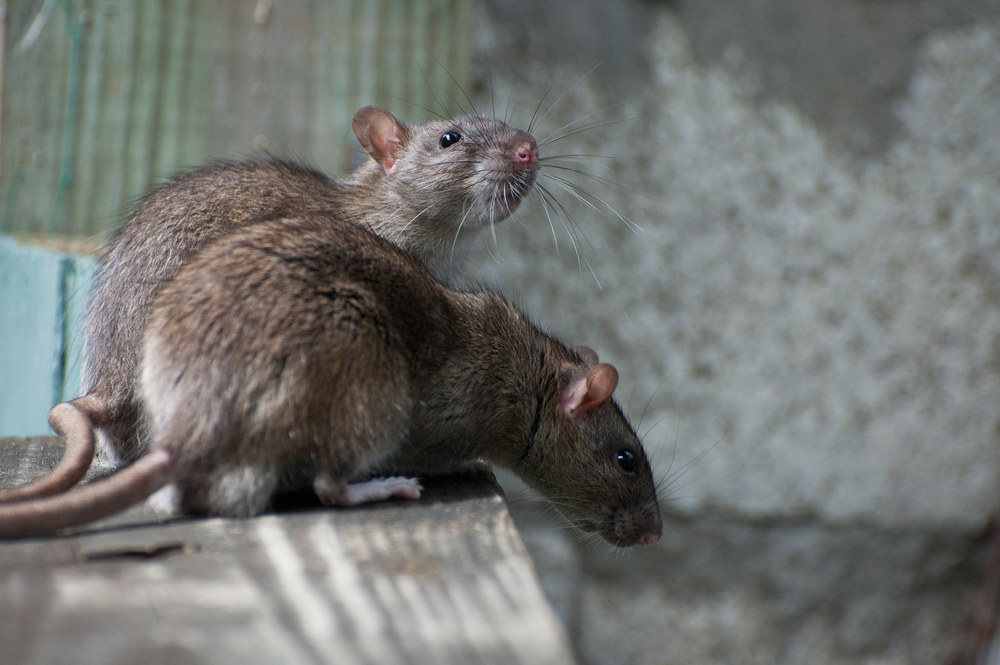
The rats we find in GTA homes are almost always Norway rats, also called brown rats. They aren't native: the City of Toronto's Mammals of Toronto guide explains that they reached North America aboard ships from Europe beginning about 1775 and were already "common" in the warehouses along Toronto's waterfront by 1830. The City of Toronto describes an adult as 200 to 480 grams and 30 to 45 cm long including the tail, an excellent swimmer, climber and jumper that lives in burrows near ground level around buildings and may travel up to 100 feet from its burrow. Health Canada adds that Norway rats build tunnel systems at ground level and prefer damp spots like crawl spaces and building perimeters.
Rats breed fast. Norway rats can breed year-round, producing about five litters averaging nine young, the same guide notes, and a City of Toronto report says one pair can produce hundreds of offspring in a year. That's why a couple of rats can become a much bigger job within months, and why we focus on the way in, not only the rats you've seen.
Two GTA details shape how we plan a rat job. First, rats on private property are the owner's responsibility. The City's rat control page tells residents to hire a pest control company for infestations on private property, and Toronto Animal Services asks people not to report common pests such as rats or mice. Second, the problem is growing. Rodent-related service requests to the City rose from 1,165 in 2015 to 2,523 in 2024, the City's report notes, and in July 2025 City Council adopted a Rat Response Plan that asks City-led construction projects to include rat management. A study of 16 cities in Science Advances found Toronto among the five with the strongest rise in rat numbers. As Tisha Hicks explains in her post on Toronto's rat problem, construction pushes colonies out of the ground and milder winters let breeding run longer. Skedaddle founder Bill Dowd has also talked about Toronto's rat population on Global News Toronto.
Every rat job starts at ground level, with the yard, foundation and garage, then moves inside to the basement, walls and attic. We confirm where the rats are active, where they're burrowing and nesting, and every opening they could use. Then we write up the removal, sealing and cleanup your home needs.
Your technician walks you through what they found and leaves an itemized written quote on site, so you know the plan and the price before any work begins.

We trace every route the rats use, from burrows in the yard to openings in the foundation and walls. Then we place one-way doors over the active openings where appropriate, so the rats can leave but can't get back in.

Once the rats are out, we remove droppings, nesting material and soiled insulation from the areas they used. We decontaminate those spaces and deal with the odours and scent trails that can draw more rats in, as set out in your quote.

We seal the entry points and every other gap we found at the foundation, vents and utility lines, using galvanized steel screening and other durable materials that stand up to gnawing. All of it carries our lifetime guarantee on all workmanship and materials.
Rats are active in the GTA all year, but where they live and what you notice shift with the seasons.
| Season | What may change | What it means for the homeowner |
|---|---|---|
| Winter(Dec–Feb) | Rats are more likely to stay hidden inside warm buildings, nesting near insulation, storage areas and mechanical spaces. Norway rats can breed year-round. | Rats that are already inside won't leave on their own. Scratching, droppings and odours are often easier to notice now. |
| Spring(Mar–May) | Warmer weather supports breeding, and females look for quiet nests near steady food in garages, sheds, wall voids and crawl spaces. Burrows near foundations become more noticeable. | A few rats can become many by summer. The sooner the gaps are closed, the smaller the job. |
| Summer(Jun–Aug) | Rats feed on gardens, compost, pet food and garbage, and young rats born in spring start exploring decks, fences, sheds and laneways. | A good time to have the yard, foundation and garage checked and sealed. |
| Fall(Sep–Nov) | As temperatures drop, rats move closer to buildings looking for warmth, shelter and food for the winter. | Call at the first droppings or scratching. We'll trace every way in and seal it before rats settle in for the winter. |
Because a rat can get through a hole the size of a quarter, we seal every gap we find, not only the ones in use today.
With rats, how they get in matters more than how many you've seen. Here's how we approach a rat job.
Where one-way doors are appropriate, they go on only after we've found the active openings, so the rats leave on their own and can't get back in. Our approach doesn't rely on poison. Rats are wary of new objects and often avoid poison and traps, poisons can be dangerous for pets, and a rat that dies inside a wall leaves an odour.
Seeing one rat often points to more nearby, and one pair can produce hundreds of offspring in a year. Trapping a few doesn't stop the rest, or the next ones, from using the same route. Closing the route does.
Rats leave droppings, urine, nesting material and a strong odour wherever they travel and nest. We remove droppings, nesting material and soiled insulation, decontaminate the affected areas and deal with the scent trails that draw other rats. Insulation is restored where it's needed.
We seal the openings rats used and the weak spots around them with galvanized steel screening and other durable materials, at foundations, vents, utility lines and burrow access points, then plan for gnawing pressure. Vents get metal screening that lets air move but keeps rats out. Our lifetime guarantee covers all workmanship and materials on the exclusion work in your quote. Parts of the property we didn't seal aren't covered.
Tell us what you're seeing and where. We'll inspect the property from the yard and foundation to the roof, find every way in, and set out the removal, sealing and cleanup in a written quote.
Skedaddle removes rats across the Greater Toronto Area: in Toronto, North York and Scarborough; in Oshawa, Whitby, Ajax and Pickering in Durham Region; in Markham and Newmarket in York Region; in Mississauga in Peel Region; and in Oakville and Burlington in Halton Region.
Toronto gives rats plenty to work with. Older neighbourhoods, laneways, restaurant districts, aging sewer pipes and constant construction all shape where they turn up, and when construction, flooding or cold disrupts their burrows, rats move closer to homes. Tisha Hicks's post on transit construction describes rats pushed out of their underground habitats finding new shelter in basements, garages and under decks.
The GTA's green spaces carry rats close to homes too. Toronto's ravine system runs more than 300 kilometres and covers about 17 per cent of the city's land, according to the City of Toronto's Ravine Strategy report. Beyond the city, Rouge National Urban Park spans parts of Toronto, Markham and Pickering, the Oak Ridges Moraine stretches 160 kilometres across the region's northern edge, and Burlington backs onto the Niagara Escarpment at Mount Nemo. Parks and green space offer cover, moisture and food, and the closer they are to homes, the more likely rats are to push into nearby yards, as Tisha notes in her post on Toronto's rat problem.
Rats aren't only a downtown problem. Our Durham Region team notes that rats are now often found in busy communities like Oshawa, Ajax, Pickering and Whitby, and our Whitby team's post on winter rat infestations describes redevelopment in downtown Whitby and Toronto driving activity each year. In York Region, Tisha's post on how rats travel through your home explains that activity usually starts shortly after sunset and runs through the night, with rats getting in through gaps in foundations, rooflines, vents and utility openings.
Our GTA team knows these houses. General Manager Tisha Hicks has led the Toronto and Durham Region locations since 2017 and writes many of our local rat posts, and Field Supervisor Colin Sears, a graduate of Fleming College's Fish & Wildlife program, trains and mentors our new technicians. Whether it's a Leslieville semi beside a laneway, a Mississauga home near new construction or a house in Oshawa with an older foundation, we follow the same steps: find every way in, get the rats out and seal the property.
Have a question about rats at your home? Here are the ones we hear most.
The cost depends on how many openings need sealing, whether rats are burrowing along the foundation, how far droppings and urine reach and how much cleanup the space needs. One gap behind a garage is a different job from a basement with several. We inspect first and leave an itemized written quote on site before any work begins.
Same-day service is often available, and many customers mention our quick response in their reviews. It isn't guaranteed, because availability depends on crew scheduling and the time of year. If rats are active in your kitchen or living space, tell the office right away. Those calls get priority, the same as with our Ottawa team.
We trace how the rats are getting in, then place one-way doors over the active openings where appropriate, so they can leave but can't get back in. Once they're out, we clean and decontaminate the areas they used and seal every opening with galvanized steel screening and other durable materials.
Skedaddle removes rats across the GTA: Toronto, North York and Scarborough; Oshawa, Whitby, Ajax and Pickering in Durham Region; Markham and Newmarket in York Region; Mississauga in Peel Region; and Oakville and Burlington in Halton Region. Call (289) 801-0601 with your address and we'll confirm service.
Our lifetime guarantee covers all workmanship and materials on the entry points we seal as part of your rat job. If one of those sealed points fails, we come back and repair it. The guarantee applies to the exclusion work in your quote, not to parts of the property we didn't seal.
Cleanup is assessed during the inspection and written into your quote when the space needs it. That can include removing droppings, nesting material and soiled insulation, decontaminating the area and dealing with odours and the scent trails rats leave for each other. We don't assume every basement or attic needs a full restoration.
Our approach doesn't rely on poison. Rats are wary of new objects, so they often avoid traps and bait, and Health Canada says baits shouldn't be the only method used. Poison can put pets at risk, and a rat that dies inside a wall leaves an odour. We get rats out and seal the way in.
The City of Toronto says the risk of illness to the public is low, but rats contaminate food and damage property. Rat urine can spread leptospirosis, according to the Public Health Agency of Canada. Never sweep or vacuum dry droppings: Health Canada warns the dust can cause illness.

You don't have to spot one to have a problem. Rats are showing up more and more in Toronto and other busy Ontario neighbourhoods,…
Read the full article
You unlock the front door of your business to start the day. You flip on the lights, ready to welcome your first customers. Then…
Read the full article
You may notice new towers, condos, and road work popping up all over Toronto. Construction changes the city, but it also impacts animals living…
Read the full articleSkedaddle has been removing wildlife humanely since 1989. We plan every GTA rat job around the routes rats use to get in, and we back our sealing work with a lifetime guarantee on all workmanship and materials. We'll inspect your property, get the rats out humanely, seal the way in and clean up wherever the inspection shows it's needed.
 menu